Disembodied intelligence describes competent performance without direct bodily interaction or lived sensory-motor experience. Its absence may leave something out of human-like mental life, but does not by itself rule out intelligence. section 9.5.3 section 9.6
Three comparisons clarify what disembodiment does—and does not—show:
- We may recognize intelligence through communication, memory, and reasoning before knowing a being’s body; sensory or movement impairments do not erase human intelligence. section 9.5.3
- Much human knowledge and abstract reasoning depends on symbols, records, instruments, testimony, and education rather than direct experience. section 9.5.3
- Artificial systems can gain partial contact with the world through task-specific sensors, actions, and feedback, without having human biology. section 9.5.3
Embodiment critiques remain relevant: intelligence may involve agency, world models, and a lived position from which the world matters. Fluent performance alone does not settle questions of grounding or understanding, and unreliable output does not by itself prove cognition is absent. section 9.6 section 9.6
Figure 9.12 We often infer intelligence through communication before knowing the body or mechanism behind it. If an extraterrestrial source produced memory, reasoning, and problem solving through signals alone, embodiment would not be the first condition we demanded.

The signal-based extraterrestrial example illustrates how intelligence might be inferred before a body or mechanism is known. section 9.5.3
Figure 9.13 Intelligence need not depend only on direct bodily experience. Humans acquire much of their knowledge through symbols, records, instruments, testimony, and education, while artificial systems can be connected to the world through sensors, actions, and feedback without sharing our biological form.
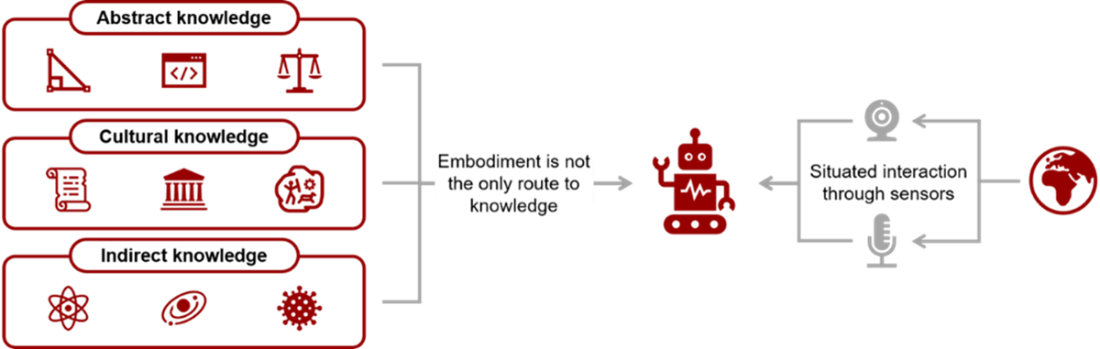
The figure contrasts mediated human knowledge with artificial systems’ sensorimotor connections to the world. section 9.5.3
