A distance-vector routing protocol lets routers build routing tables by sharing known destination networks, metrics, and next-hop information with neighbors. Each router knows the metric and next hop for a destination, but not a complete network map. This behavior is also called routing by rumor. section 17.2.1 section 17.5
Key characteristics include:
- Uses an Interior Gateway Protocol algorithm within a single autonomous system. section 17.5
- Compares route metrics, preferring the lower metric when choosing between learned paths. section 17.2.1
- Includes Routing Information Protocol (RIP) and Enhanced Interior Gateway Routing Protocol (EIGRP); EIGRP is an advanced distance-vector protocol. section 17.2.1
- Differs from link-state routing, where routers build a connectivity map before calculating routes. section 17.5
Choosing a next hop
Suppose R1 learns about LAN A from R2 with metric 2 and from R5 with metric 1. R1 installs the route through R5. It knows the next hop and metric, but not the network details beyond those neighbors. section 17.2.1
Figure 17.7 Routers share routing information with a distance-vector routing protocol. R1 learns of LAN A from both R2 and R5 but inserts the route via R5 into its routing table due to the lower metric value.
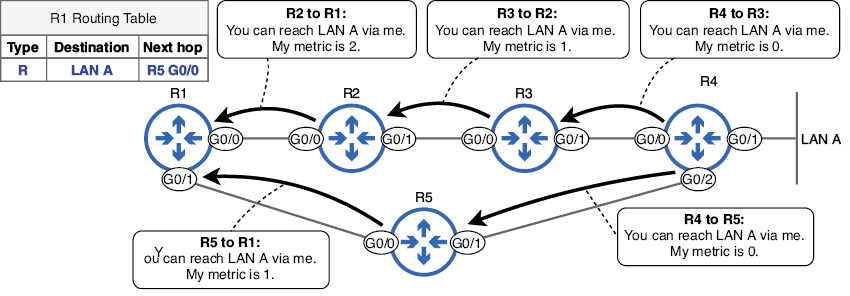
Compare the two learned paths to see why the lower metric determines R1’s selected route. section 17.2.1
