Enhanced Interior Gateway Routing Protocol (EIGRP) is a Cisco-developed interior gateway protocol with advanced distance-vector characteristics. Routers exchange known networks, metrics, and next-hop information rather than maintaining a complete network map. section 17.2.1 section 17.5
EIGRP prefers routes with lower metrics. Its default metric calculation uses bandwidth and delay, with a more complex formula capable of considering additional parameters. section 17.3.1
Keep these route-selection rules separate:
- During routing-table population, administrative distance and metrics help select routes that enter the table. section 17.3.3 section 17.5
- During packet forwarding, the router chooses the most specific matching route already present in the routing table. section 17.3.3 section 17.5
- Routes with different prefix lengths represent different destinations for table population, even when their address ranges overlap. section 17.3.3
Reading an EIGRP route
A Cisco IOS route shown as `D 203.0.113.0/26 [90/5678] via 192.168.1.10` identifies an EIGRP-learned route. The `D` code marks EIGRP, while the bracketed values represent administrative distance and metric. In the example, EIGRP, RIP, OSPF, and static routes for different prefix lengths all enter the routing table. section 17.3.3
Figure 17.15 The four routes in the example overlap. 203.0.113.0/24 includes 203.0.113.0–.255, 203.0.113.0/25 includes 203.0.113.0–.127, 203.0.113.0/26 includes 203.0.113.0–.63, and 203.0.113.0/27 includes 203.0.113.0–.31. However, IOS considers them to be routes to different destinations and will insert all four routes into the routing table.
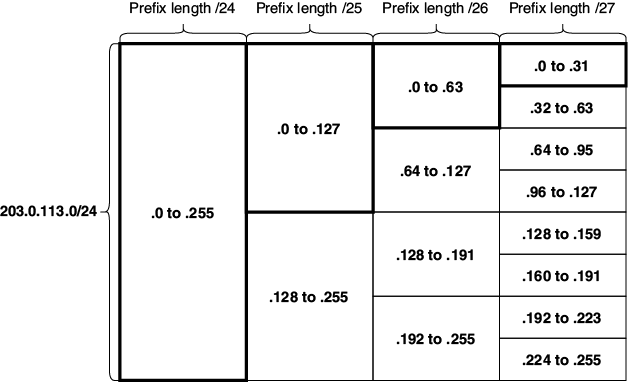
Use the overlapping-prefix diagram to distinguish route-table population from the later most-specific-route forwarding decision. section 17.3.3
