Distributed training fits a machine learning model across multiple nodes after data ingestion. Workers concurrently consume processed data and calculate updates, allowing training to use clustered compute when datasets, models, or runtime demands exceed a single machine. section 3.1 section 3.0
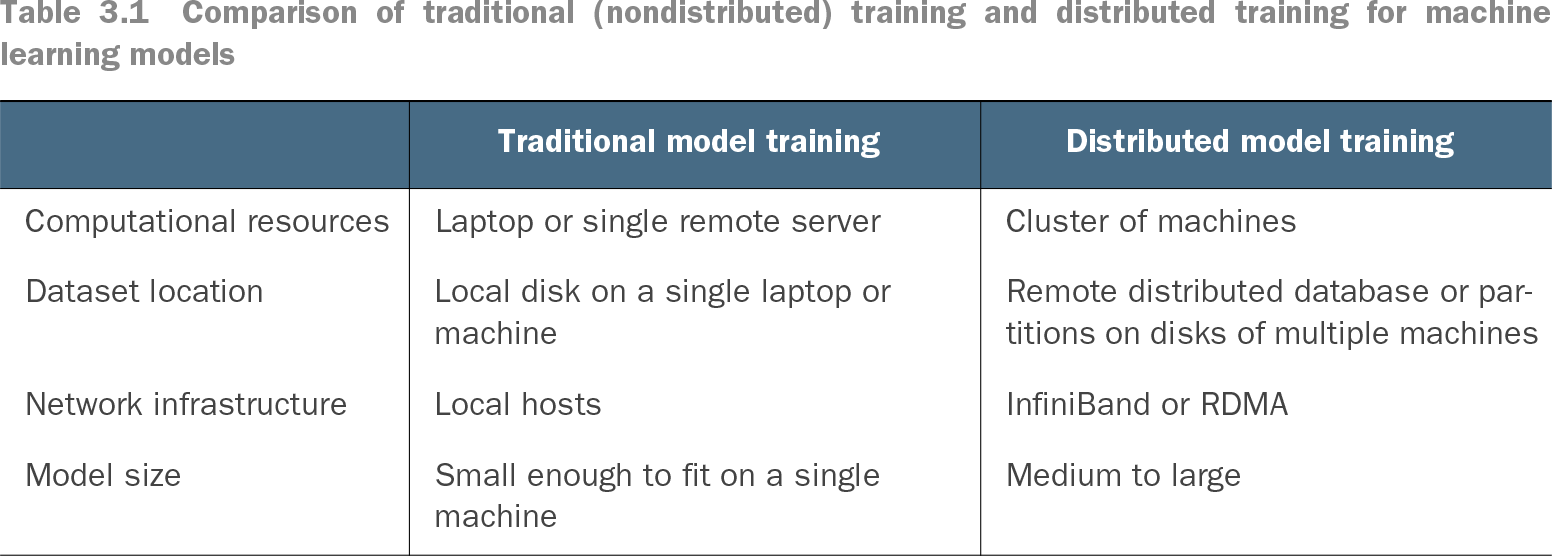
Table 3.1 Comparison of traditional (nondistributed) training and distributed training for machine learning models (view table figure)
| Remote distributed database or partitions on disks of multiple machines |
||
Compare single-machine and distributed training by compute location, dataset placement, network infrastructure, and model size. section 3.1
Choose the coordination pattern by model size and communication cost:
- Use parameter servers for large, complex models that cannot fit on one machine; partition model parameters across servers while workers send gradients for updates. section 3.9 section 7.3.2
- Use collective communication for smaller models when parameter-server traffic becomes a bottleneck. Each worker holds a full parameter copy, computes gradients on a data partition, and synchronizes updates through collective operations such as all-reduce. section 3.9 section 7.3.2
- Plan for failures as part of training: skip unusable corrupted batches, checkpoint model parameters during network instability, and resume after connectivity returns. Synchronous collective communication can block the whole job when the network is slow. section 3.4.2
Multi-worker TensorFlow job
For synchronous multi-worker training, create a tf.distribute.MultiWorkerMirroredStrategy, define the distributed input pipeline and model inside its strategy scope, then call fit(). The strategy copies layer variables across workers and uses collective communication. Save the completed model only from the chief worker, identified through TF_CONFIG, to avoid incorrect or redundant output. section 9.2.2
Operational deployment can package the training script in a container and run a two-worker Kubeflow TFJob on Kubernetes with persistent storage for checkpoints and saved models. An Argo workflow can place data ingestion before parallel distributed runs for CNN, dropout, and batch-normalization variants, then select a top model and create model serving. section 9.2.2 section 9.4.1