The DNS hierarchy organizes internet names as a tree. The root domain (.) contains top-level domains such as com, net, and org; each TLD contains second-level domains, which can contain further subdomains. section 3.1.3
Read a domain from its position in the hierarchy:
- Root domain: the single dot (.). section 3.1.3
- Top-level domain: labels such as com, net, or org. section 3.1.3
- Second-level domain: an organization-controlled label such as google under com. section 3.1.3
- Lower-level domains: additional third-level, fourth-level, and other subdomains. section 3.1.3
The www label
In www.example.com, www conventionally names a server hosting an organization’s main website; it is not a technical requirement, and DNS can make www.example.com and example.com reach the same site. section 3.1.3
Figure 3.3 The DNS hierarchy. All domains are under the root domain, represented by “.”. Under the root domain, there are various top-level domains. Under each top-level domain, there are various second-level domains. The “google” domain, a subtree under the “com” top-level domain, is highlighted.
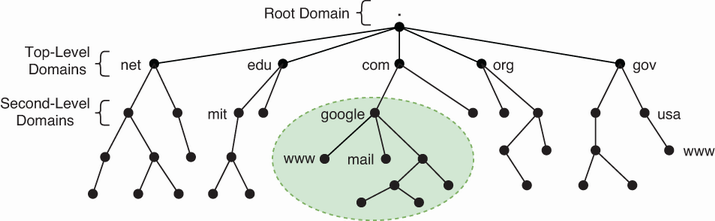
Use the hierarchy diagram to trace the root, TLD, and second-level domain relationships. section 3.1.3
