When a model must answer what would happen if a variable were deliberately set, correlation is not enough. Do-calculus transforms intervention-based probability expressions into quantities that can be estimated from observational data, when a causal graph supplies the required assumptions. section 1.5.3 section 10.4.1
The system contains three if-then rules. Each rule links a graphical condition to an equivalent probability query: if variables are d-separated after graph surgery on a DAG, a probability expression may be inserted, removed, or transformed. The rules derive from d-separation, ideal interventions, and probability laws rather than intuition alone. section 10.4.1
A practical workflow treats do-calculus as an identification step between causal modeling and statistical estimation:
- Represent the causal question as an intervention, such as the target distribution under setting X to x. section 10.4.1
- Use graph structure and d-separation to transform the intervention expression into an observational estimand. section 10.4.1
- Estimate the resulting terms with statistical or machine-learning models, while weighing bias, variance, scalability, and parallelizability. section 1.5.3
- Automate identification with graphical software, or use a known result such as the backdoor adjustment estimand. section 10.4.1 section 10.4.2
Writer type and image content
To estimate the causal effect of writer type on images when a randomized assignment is infeasible, a DAG and do-calculus can derive an expression for conditional average treatment effects. The left side represents hypothetical interventions; the right side contains terms estimable from labeled image data. A related derivation applies rules 2 and 3 to obtain a backdoor estimand, with c-component factorization supplying an intermediate step. section 1.5.3 section 10.4.2
Figure 1.8 Visualization of an example CATE of writer type on an image. It is the pixel-by-pixel difference of the expected image under one intervention (W="high school") minus the expected image under another intervention (W="bureaucrat"), with both expectations conditional on being images of the digit 4 with a certain level of thickness.
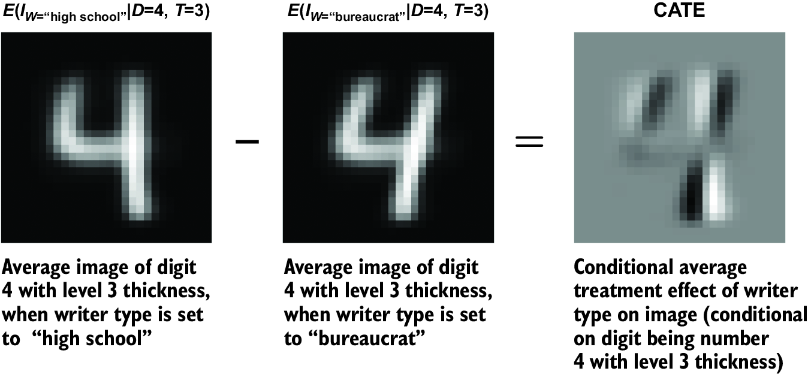
Compare two interventions as a pixel-by-pixel difference between their conditional expected images, making the causal query concrete. section 1.5.3
