Domain ownership assigns responsibility for delivering high-quality, agreed-upon data to the departments that understand it, rather than to a central data team. Departments treat data as a product for other departments or external partners; the central team provides platform infrastructure and supports governance such as access control, security, and compliance. section 18.1.2
This division addresses the weakness of centralized collection: data engineers may gather everything centrally without being able to judge its quality, allowing a data lake to become a data swamp. Ownership keeps quality and meaning close to the producing domain while enabling shared access. section 18.1.3 section 18.1.2
A domain owning its data is expected to:
- Deliver high-quality, agreed-upon data in a well-documented format for consuming teams. section 18.1.2
- Satisfy the needs of consumers by treating data as a product, potentially serving external partners as well as internal departments. section 18.1.2
- Document and communicate changes; for significant changes, coordinate schema evolution and compatibility with the central data team. section 18.1.3
- Use self-service infrastructure to publish, consume, and modify data while following data protection and governance rules. section 18.1.2
A domain-owned data product
A department publishes an agreed-upon, documented data product for other teams. Those teams consume it through shared infrastructure without lengthy central requests, while the central data team supplies the platform, advises on best practices, and helps preserve compatibility when the product changes. section 18.1.2 section 18.1.3
Figure 18.1 The core principles of a data mesh
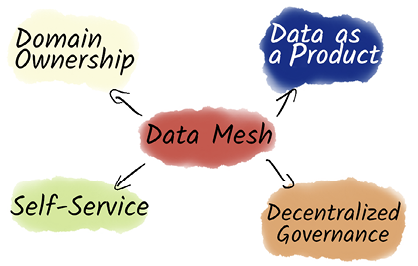
Use the figure to place domain ownership alongside data as a product, self-service data infrastructure, and decentralized governance within the data mesh. section 18.1.2
