A specialized term or phrase carries meaning characteristic of a particular subject area. In search, recognizing it prevents a query from being treated as unrelated keywords and improves interpretation of user intent. section 5.0 section 6.4.2
Search systems can learn specialized terminology from document content and user-generated signals. Knowledge graphs model relationships among terms, while query logs reveal related phrases, refinements, misspellings, and alternative spellings in actual behavior. section 5.0 section 6.3 section 6.7
A practical search pipeline can:
- Extract phrases from documents or queries, using noun-phrase or part-of-speech filtering and application-specific query parsing. section 6.4.2
- Mine query logs by grouping searches by user and time, then compare repeated patterns across users to identify likely relationships. section 6.3
- Classify queries and disambiguate terms with multiple meanings before expanding or rewriting the query for search. section 6.0 section 6.6
Why phrase extraction matters
A lexical engine may parse “new york city” as new AND york AND city and score each word separately. Recognizing “new york city” as a domain phrase preserves its combined meaning for more accurate ranking. section 6.4.2
Figure 6.2 A typical sequence of searches from query logs for a particular user
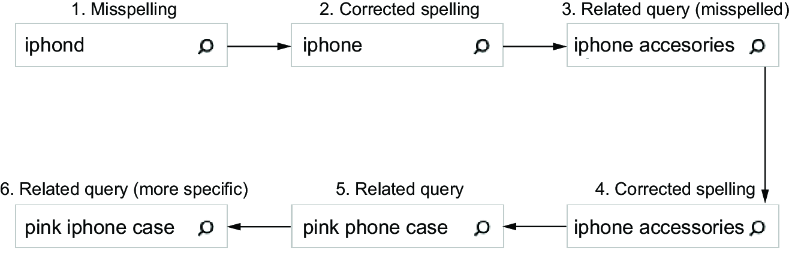
Use the query-log sequence to inspect how successive searches can reveal refinements, related phrases, and possible misspellings. section 6.3

