A domain team is an autonomous development team responsible for delivering and operating capabilities within a defined product domain. In platform engineering, domain teams divide a growing platform into smaller parts while following shared engineering principles and responding to user feedback. section 1.3 section 9.0
A domain team typically owns responsibilities close to the applications or services it supports:
- Configure service-specific dashboards, define meaningful alerts, and publish traces for operational monitoring. section 5.2.3
- Use platform-provided tools and frameworks while retaining responsibility for insights into the team’s own services. section 5.2.3
- Scale independently within clear domain boundaries, using shared principles and self-service interactions with other platform teams. section 1.3 section 9.0
The pattern separates responsibilities without creating isolated teams. A platform team maintains shared mechanisms such as metrics scraping, trace ingestion, storage, and hosted observability tools; domain teams apply those capabilities to their services. As adoption grows, event-driven releases and contract tests help preserve reliability and trust across team boundaries. section 5.2.3 section 9.0
Observability ownership
An application team monitors its own service by creating dashboards, setting response-time or error-rate thresholds, and publishing traces. The platform team provides the collection, ingestion, storage, and hosting infrastructure needed to make those signals usable. section 5.2.3
Figure 1.3 Platform engineering depends on the disciplined application of a product delivery model. Product management drives decisions about the product’s capabilities, features, and experiences. Effective platform engineering principles enable us to deliver these more successfully. Identifying and architecting around the internal product domains of our platform is how we successfully sustain the user experience as the product evolves and scales.
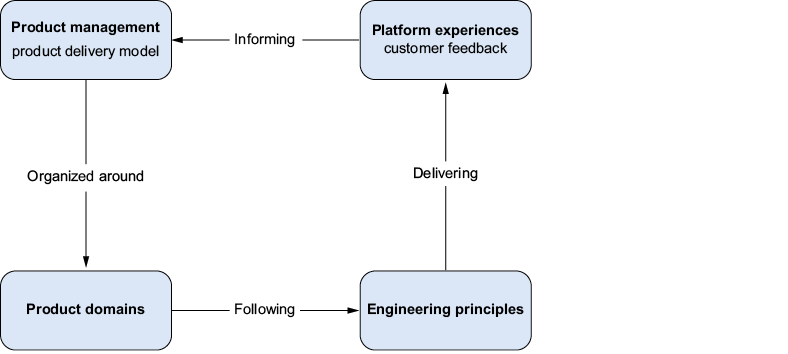
Use the platform product-delivery model to relate product management, platform capabilities, internal domains, and the user experience as the platform evolves. section 1.3
