In multiobjective optimization, the dominated region is the part of objective space covered by solutions that are no better than one or more candidate solutions. Its size summarizes how much useful objective space has been captured. section 11.5
The region is bounded by the Pareto frontier and a reference point, usually chosen at the lowest objective values. Its volume is the hypervolume: larger values indicate better optimization performance. section 11.5
In Bayesian optimization, the dominated region supports the following workflow:
- Fit one Gaussian process to each objective and use their predictions to reason about competing objectives. section 11.3
- Partition the objective space relative to the reference point and compute the current hypervolume. section 11.5
- Choose queries that are expected to enlarge the region, using Expected Hypervolume Improvement to balance objectives. section 11.3
Alternating EI versus EHVI
When two objectives prefer opposite regions of the search space, alternating Expected Improvement policies query each objective's preferred area. EHVI instead assigns high acquisition scores to multiple regions likely to extend the Pareto frontier, producing larger average hypervolume in the comparison. section 11.3
Figure 11.11 The current GP belief about each of the two objective functions (top), the corresponding EI acquisition scores (bottom left), and the EHVI acquisition scores (bottom right). EHVI balances the two objectives, assigning high acquisition scores to multiple regions that likely extend the Pareto frontier.
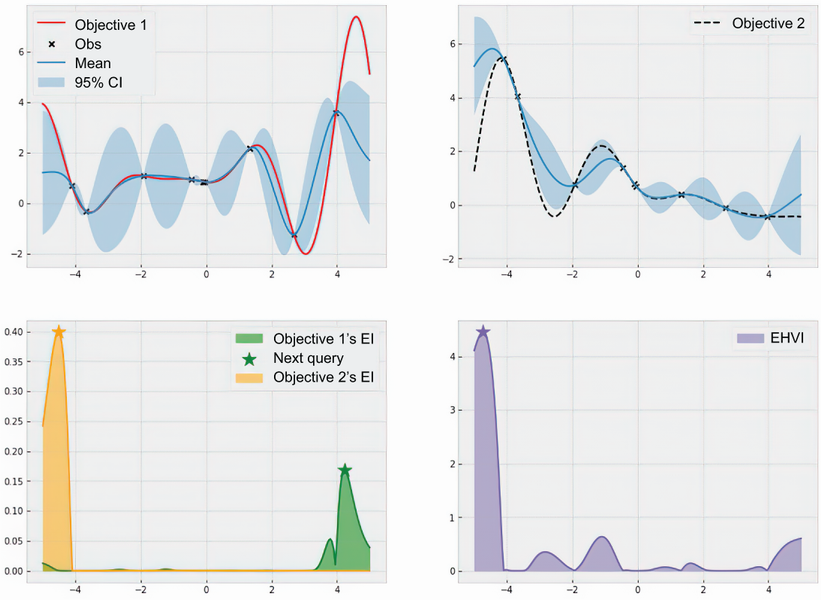
Compare separate single-objective acquisition scores with EHVI scores that target several regions capable of extending the Pareto frontier. section 11.3
