Hypervolume measures the quality of a set of solutions when objectives conflict. Rather than asking for one best point, it measures how much objective space is covered by the set’s nondominated outcomes. A larger dominated region indicates a better approximation to the trade-offs available between objectives. section 11.2 section 11.5
For two objectives being maximized, first identify the nondominated points: no other observed point improves one objective without worsening the other. These points form the Pareto frontier. Choose a reference point below the objective values of interest; hypervolume is the area between that point and the frontier. In more objectives, the same idea becomes a volume in higher-dimensional objective space. section 11.2 section 11.5
Comparing two search result sets
Consider two conflicting one-dimensional objective functions whose maxima lie near opposite ends of the search space. A dense grid of evaluations traces much more of the trade-off boundary than 20 random evaluations, so its dominated hypervolume is larger. Hypervolume therefore compares complete datasets, rewarding both strong objective values and coverage of the frontier rather than performance on only one objective. section 11.2
Figure 11.8 The reference point in a multiobjective optimization problem, which sets a lower bound for the dominated space. The hypervolume is computed to be the volume of the region between the reference point and the Pareto frontier.
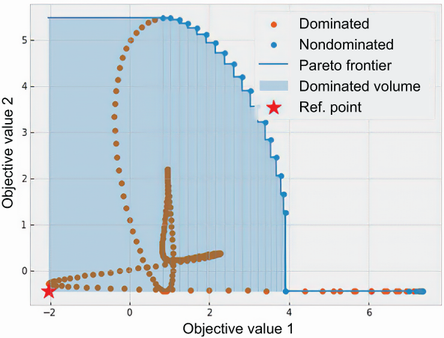
Use the reference point as the lower corner and the Pareto frontier as the upper boundary of the region being measured. section 11.2
Hypervolume can also guide Bayesian optimization. Expected Hypervolume Improvement (EHVI) scores candidate queries by their potential to extend the current frontier, balancing competing objectives instead of alternating between separate single-objective searches. Across repeated query budgets, average hypervolume provides a direct way to compare such policies. section 11.3 section 11.5
In BoTorch, construct a DominatedPartitioning object from the reference point and observed objective values, then call compute_hypervolume(). The reference point is commonly set to the lowest values of the objectives being optimized, so it fixes the endpoint of the measured dominated space. section 11.2 section 11.5
Airplane design exercise
For a four-dimensional airplane-design search space, flight utility and negated flight cost form two objectives. Evaluate EHVI and alternating Expected Improvement over repeated 50-query experiments, then plot their average hypervolumes and error bars to compare how effectively they discover trade-offs. section 11.4
