ExpectedHypervolumeImprovement (EHVI) chooses the next evaluation by estimating how much a candidate is expected to increase the dominated hypervolume of a multiobjective solution set. It generalizes Expected Improvement (EI): instead of improving one objective, it seeks points that may extend several parts of the Pareto frontier. section 11.3 section 11.5
The acquisition score reflects both predicted objective values and uncertainty. EHVI evaluates the expected hypervolume increase probabilistically; its calculation partitions the dominated region into hyperrectangles. Compared with alternating single-objective EI policies, it can assign meaningful scores to multiple regions that might extend the Pareto frontier. section 11.3
BoTorch implementation
Fit one Gaussian process per objective, combine them with ModelListGP, and define a reference point representing the lower endpoint of the dominated region. FastNondominatedPartitioning supplies the current partitioning. Construct ExpectedHypervolumeImprovement with the combined model, reference point, and partitioning, then optimize it with optimize_acqf. A practical comparison alternates EI between two objectives and tracks average hypervolume; EHVI consistently performs better in the demonstrated experiment. section 11.3 section 11.5
Airplane-design exercise
Apply EHVI to a four-dimensional airplane design problem with flight utility and negated flight cost as objectives. Use the reference point [-1.5, -2], run 10 experiments with 50 queries each, and compare EHVI with alternating EI using average hypervolume and error bars. section 11.4
Figure 11.11 The current GP belief about each of the two objective functions (top), the corresponding EI acquisition scores (bottom left), and the EHVI acquisition scores (bottom right). EHVI balances the two objectives, assigning high acquisition scores to multiple regions that likely extend the Pareto frontier.
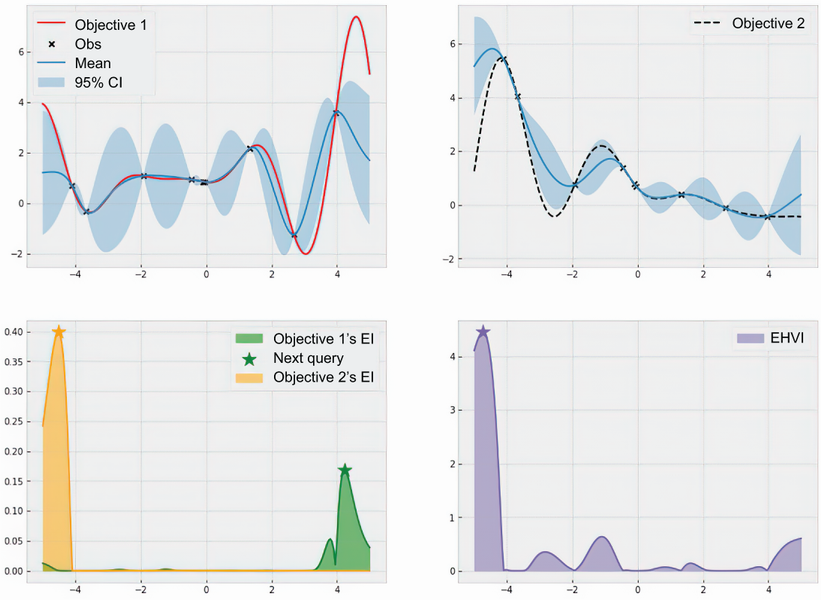
Compare separate EI scores with EHVI scores to see how multiobjective acquisition balances regions likely to extend the Pareto frontier. section 11.3
