Multi-parameter, or multiobjective, optimization seeks inputs that score well on several objectives at once. It matters when optimizing one goal alone harms another: a predictive model may be accurate yet too large or costly for real-time use. section 11.0 section 11.1
Conflicting objectives usually rule out one universally best point. A point is nondominated when improving one objective requires worsening at least one other. The nondominated points form the Pareto frontier, the boundary of attainable trade-offs; no point lies beyond it in every objective. section 11.2 section 11.5
Figure 11.6 The Pareto frontier that traces through the nondominated points. No data point lies beyond (above and to the right of) this Pareto frontier.
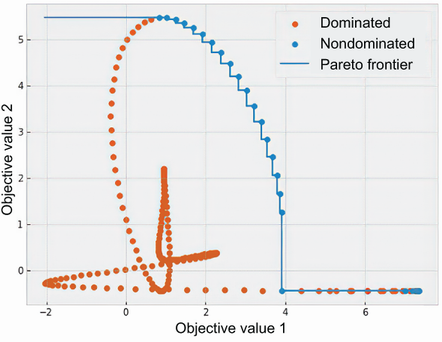
Compare objective values directly: dominated points fall behind another point, while stars mark the trade-offs retained on the Pareto frontier. section 11.2
For expensive black-box objectives, Bayesian optimization keeps one Gaussian process (GP) model per objective. The models support joint reasoning about candidate inputs while leaving most of the usual BayesOpt workflow intact. section 11.1 section 11.5
Dominated hypervolume measures the objective-space region between a reference point and the Pareto frontier. Larger hypervolume indicates a stronger set of trade-offs. Expected Hypervolume Improvement (EHVI) uses GP predictions to choose evaluations expected to expand that region. section 11.2 section 11.5
Two conflicting one-dimensional objectives
A Forrester-based objective peaks near x = 4.5, while a second objective peaks near x = −4.5. Joint optimization therefore collects points between these extremes rather than selecting only either single-objective optimum. section 11.2
Airplane aerostructural design
Optimize flight utility and negated flight cost over a four-dimensional unit search space. Fit GP models, use a reference point of [−1.5, −2], and compare EHVI with alternating expected improvement through average hypervolume. section 11.4
