An inner product, commonly called a dot product, multiplies corresponding components of two vectors and sums the results. It measures both directional alignment and vector magnitude. For unit-length vectors, it produces the same ranking as cosine similarity while avoiding repeated normalization. section 3.1.2
Embedding similarity
Given two embedding vectors, compute their dot product to rank similar items. With normalized embeddings, this cheaper calculation replaces cosine similarity without changing the similarity result. section 3.1.2
Latent-factor prediction
Matrix factorization represents users and items as vectors in a shared latent space. A user's predicted preference for an item is their vectors' dot product: Peter's factors produce 0.90 for Pulp Fiction and −0.18 for Toy Story. section 3.3.1
Collaborative filtering
A user-item interaction matrix can use dot products to score user similarity. Shared consumption increases the score, after which unconsumed items are ranked by how often similar users consumed them. section 1.3.2
Use the equation to connect the component-wise operation with vector similarity. section 3.1.2
Figure 3.4 Matrix factorization decomposes the user-item rating matrix (R) into two smaller matrices: user factors (U) and item factors (I). Each user and item is represented by k latent factors (typically 50-200 dimensions). The predicted rating for user u and item i is the dot product of their factor vectors.
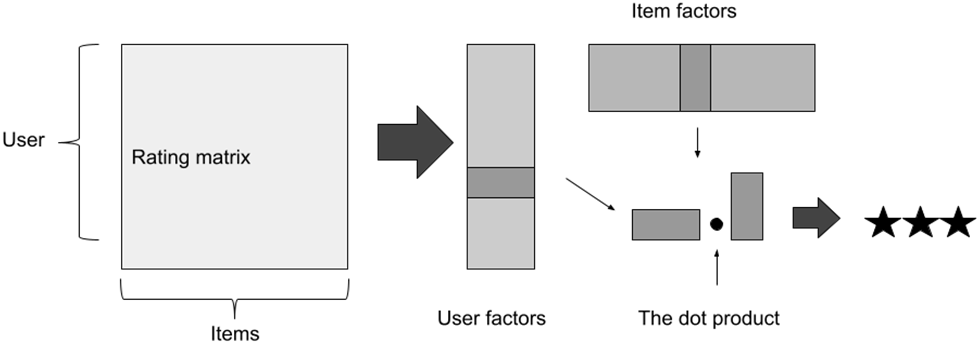
Use the matrix-factorization figure to trace how user and item factor vectors produce predicted ratings. section 3.3.1


















