The Double Diamond is a flexible design process for identifying a problem, defining it, exploring solutions, and delivering the strongest option. It alternates divergent exploration with convergent focus, helping teams move from broad investigation to purposeful action. section 3.4.2 section 3.4
Use four connected phases:
- Discover: gather research and data to understand the problem widely. section 3.4.2
- Define: filter the research and focus it into a specific problem to solve. section 3.4.2
- Develop: explore and test multiple possible solutions. section 3.4.2
- Deliver: narrow the options, refine the most successful solution, and put it into use. section 3.4.2
Treat the diamonds as a guide rather than a rigid sequence. If testing shows that solutions do not resonate with users, return to defining the problem and revise it. The same pattern can support an entire website or a single feature, with phases reduced or roles shared when the team is small. section 3.4.2 section 3.4
Applying the diamonds to a feature
For a new website feature, first research the problem broadly, then agree on the problem definition. Explore and test several solutions before refining and delivering the one that performs best with users. section 3.4 section 3.4.2
Figure 3.5 The double diamond process starts with a problem, exploring it widely and then scoping down the definition before widely exploring solutions and then scoping them down to one solution.
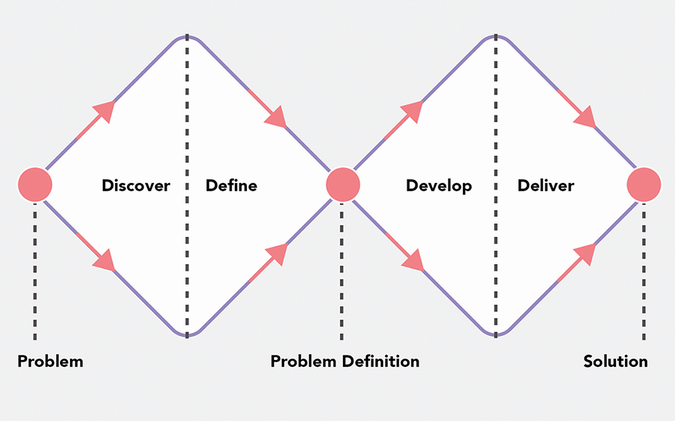
Trace the two-diamond flow from broad problem exploration to focused definition, then from broad solution development to one delivered solution. section 3.4.2
