Downsampling reduces spatial resolution so a network can move beyond individual pixels and capture larger-scale meaning. In a U-Net, the encoder progressively shrinks a noisy image while acting as a visual summarizer: “What am I looking at?” section 12.17
A downsampling layer combines several operations:
- A convolution scans feature maps with learned filters, combining local regions into new features. section 12.17
- Padding preserves border coverage, while a stride of 2 makes the output spatially smaller. section 12.17
- Additional channels let the smaller representation carry richer detected patterns; normalization and activation prepare values for later layers. section 12.17
From an 8×8 image to a smaller representation
An 8×8 noisy image first passes through eight 3×3 filters, producing an 8×8×8 set of feature maps. A later convolution uses 4×4 filters, padding of 1, and stride 2, shrinking the spatial dimensions while learning increasingly abstract features. section 12.17
Figure 12.34 The downsampling convolutional layer in our U-Net
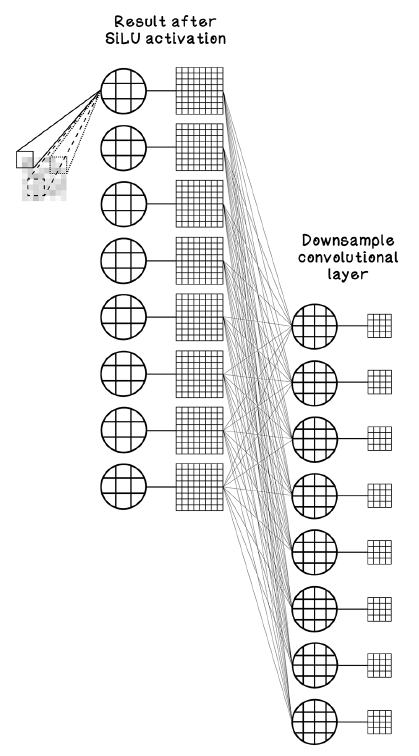
Visualizes where the downsampling convolution sits within the U-Net. section 12.17




