Downsampling reduces a dataset before training when its size makes computation unnecessarily expensive. It is a scalability choice, not an automatic data-quality fix: the retained examples must still represent the problem. section 10.3
Choose the least aggressive reduction that solves the resource problem:
- Remove exact duplicates first; this is the most straightforward option for many problems. section 10.3
- Downsample near-duplicates using a simple distance measure, such as Levenshtein distance for strings. section 10.3
- Cap samples by an internal identifier, such as a maximum number per user, or by an artificial identifier such as a cluster. section 10.3
- Keep noisy, high-volume data for training only when validation data better reflects quality; preserve metadata needed for later filtering and joins. section 6.7.2
Demand forecasting
Test whether retaining 20%, 10%, or 5% of daily store-item observations changes validation metrics. Also compare daily data with weekly aggregation: using week, store, and item reduces computation sevenfold, but the choice can alter the forecasting service and stock-management product, so involve product managers, users, and stakeholders. section 9.4.1
Figure 10.4 Vertical scaling vs. horizontal scaling
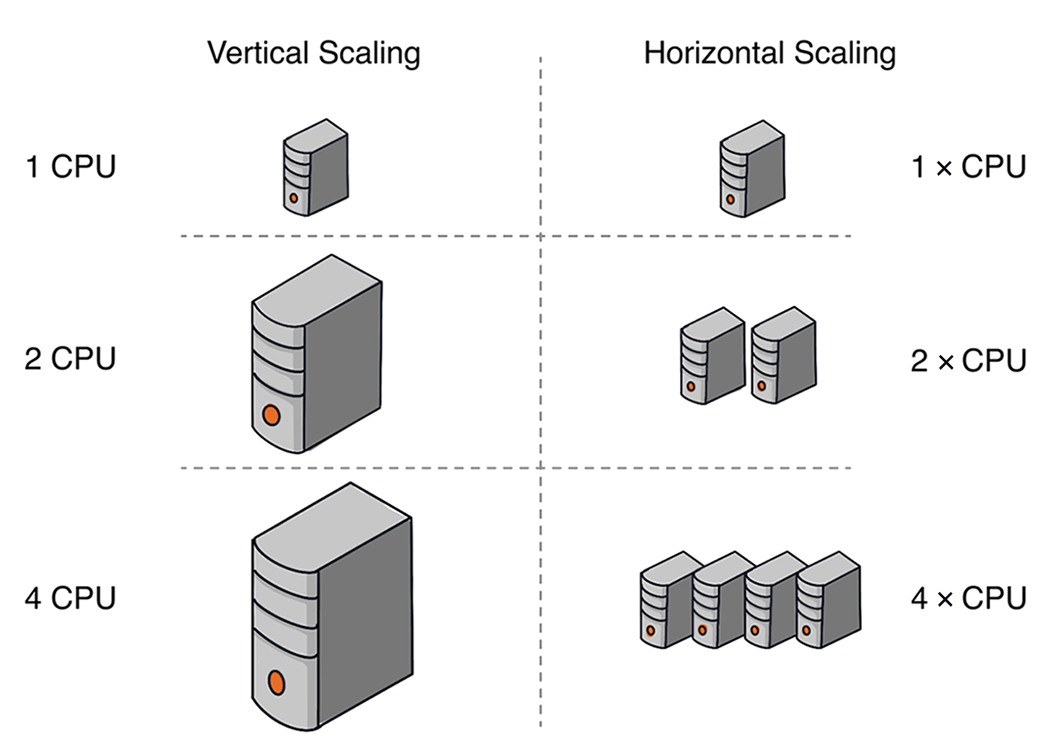
Use the scaling comparison to place downsampling alongside vertical and horizontal approaches to reducing training-system pressure. section 10.3




