DPM++ 2M is a second-order multistep diffusion sampler: think of it as a careful barber that removes noise in measured passes rather than hacking away blindly. In Stable Diffusion, its results depend not only on the sampler but also on the schedule type and step count. section 6.1.2
Use DPM++ 2M as a practical comparison tool:
- Keep the prompt, checkpoint, seed, dimensions, CFG, and schedule type fixed when comparing samplers. section 6.2.2
- Start with a modest step count, then increase it if the image looks unstable or sampler differences seem pronounced. section 6.2.2
- Treat schedule type as a creative control: it changes how much noise is removed at each step. section 6.1.2
- Do not assume DPM++ 2M is always best; visual preference can change with the prompt and settings. section 6.1.2
A quick sampler test
Generate “a sand castle on the beach” at 512×512 with Deliberate_v5, 10 steps, Karras scheduling, seed 1337, and CFG 7. Compare DPM++ 2M with DDIM and Euler. At 10 steps, DPM++ 2M may look especially sharp; at 30 steps, the three results become much more alike. section 6.2.2
Figure 6.9 Increasing the CFG scale shows limitations in higher order samplers.
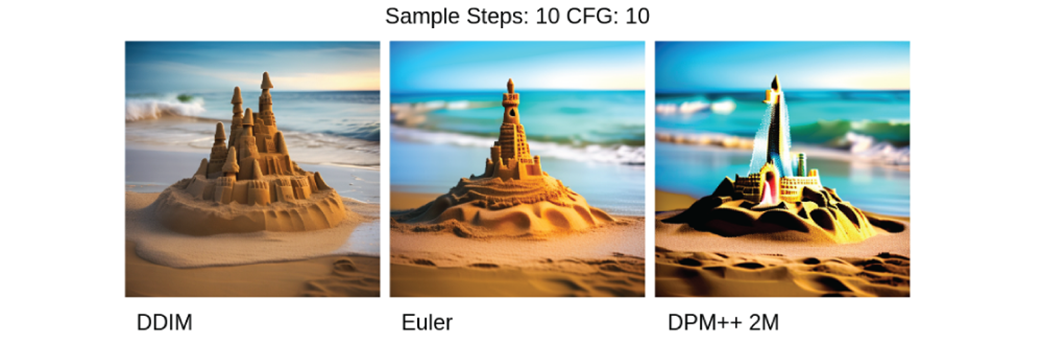
Compare the sampler outputs after raising CFG to 10; the figure illustrates a limitation for DPM++ 2M at only 10 steps. section 6.2.2