A driven adapter lives outside the application core and implements a secondary port. It translates the core’s request into actions involving infrastructure, such as saving data or sending an alert. The core depends on the port; the adapter depends inward on the core’s contract. section 5.3.3 section 5.4.1
Keep the boundary useful:
- Define the port in the core’s language, not with types from an external database or API. section 5.3.5
- Keep adapters focused on translation; put business rules in the core, not in a controller or repository. section 5.3.5
- Inject the adapter through the port, then choose and wire the implementation at the application entry point. section 5.5.2
One alert port, several adapters
A server monitor calls an alert port when its temperature is too high. A Twilio adapter sends an SMS, a console adapter prints a development alert, and a Kafka adapter publishes a message. The monitor can use any of them without creating the infrastructure itself. section 5.5.2
Figure 5.11 On the Driven Side, the Domain Logic never talks to the database directly; it simply calls a Secondary Port (Interface). The actual database or email server is hidden inside a Secondary Adapter that implements the interface, allowing you to swap out your infrastructure without changing a single line of business logic.
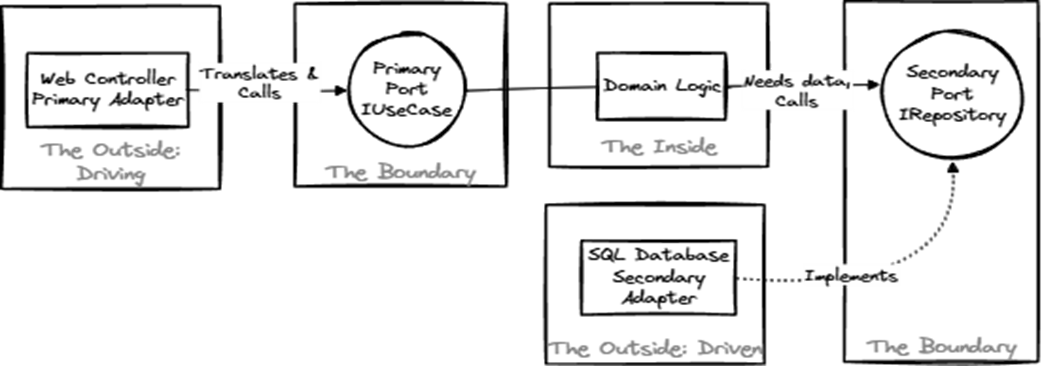
Shows how the core calls a secondary port while the adapter hides the database or email service behind that interface. section 5.4.1


