liveBook · Manning

Dropout

As explained in Evolutionary Deep Learning: Genetic algorithms and neural networks

Dropout is a neural-network regularization technique that randomly deactivates a proportion of nodes during training.

Dropout regularizes neural networks by randomly deactivating a chosen proportion of nodes during each training iteration. It helps reduce memorization and improve generalization, especially when convolutional models identify features too effectively. section 1.3.1 section 8.1.4
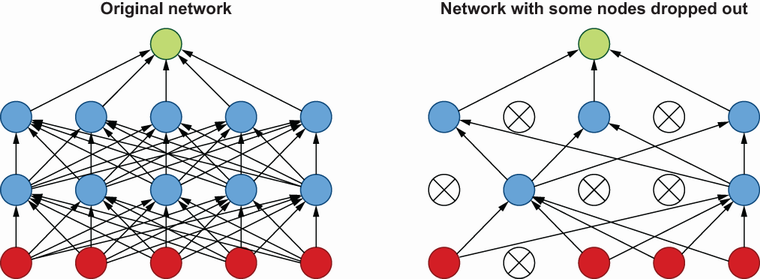
Figure 8.6 A demonstration of Dropout

Use the diagram to inspect how randomly disabling neurons changes the network during training. section 8.1.4

Practical behavior:

  • Disable neurons independently on each training iteration rather than once per epoch. section 8.1.4
  • Set the layer parameter to the proportion of neurons disabled; the example uses 0.5. section 8.1.5
  • Treat dropout as a tunable architectural choice: overusing it can produce poorer results instead of improving performance. section 8.1.5

Dropout in a convolutional autoencoder

Insert Dropout layers after pooling in the encoder and after transposed convolutions in the decoder, for example with layers.Dropout(0.5).


How Evolutionary Deep Learning: Genetic algorithms and neural networks covers it

How deep it goes
Explains iteration-level behavior, placement, parameterization, and overuse, but does not derive dropout mathematically.
Examples
Demonstrates Dropout(0.5) in convolutional autoencoder encoder and decoder layers, alongside batch normalization.
What it assumes
Assumes familiarity with convolutional layers and autoencoders while treating dropout as an added network layer.
What you can do after
Apply it via Dropout layers, adjust the disabled-neuron proportion, and evaluate whether the architecture improves validation behavior.
How it connects
Connects dropout with convolutional layers, autoencoders, batch normalization, memorization, and model generalization.

Also explained in

Compare how 12 books explain dropout →

Related concepts

This explainer was generated by Manning's knowledge graph from the text of Evolutionary Deep Learning: Genetic algorithms and neural networks. The section links point to the parts of the book it draws on.








