A drug-like molecule is a chemical compound with properties broadly compatible with functioning as a medicinal drug. Drug discovery searches for such compounds because the space of possible molecules is vast, biological systems are complex, and safety standards are rigorous. section 1.0
The molecule is considered alongside a biological target: a protein, nucleic acid, lipid, or carbohydrate whose activity may be modulated to produce a medicinal effect. Binding depends on physical interactions between flexible molecular and target conformations; their association strength is called binding affinity. section 1.1.1
Drug-like molecules matter in discovery because they:
- Occupy an enormous chemical search space, estimated at 10^63 molecules. section 1.1.1
- Must be found in relation to a chosen biological target rather than evaluated uniformly against every possible protein. section 1.1.1
- Can be prioritized through computational screening and machine-learning methods before extensive experimental work. section 1.0
Figure 1.1 Drug discovery can be thought of as a difficult search problem that exists at the intersection of the chemical search space of 1063 drug-like compounds and the biological search space of 105 targets.
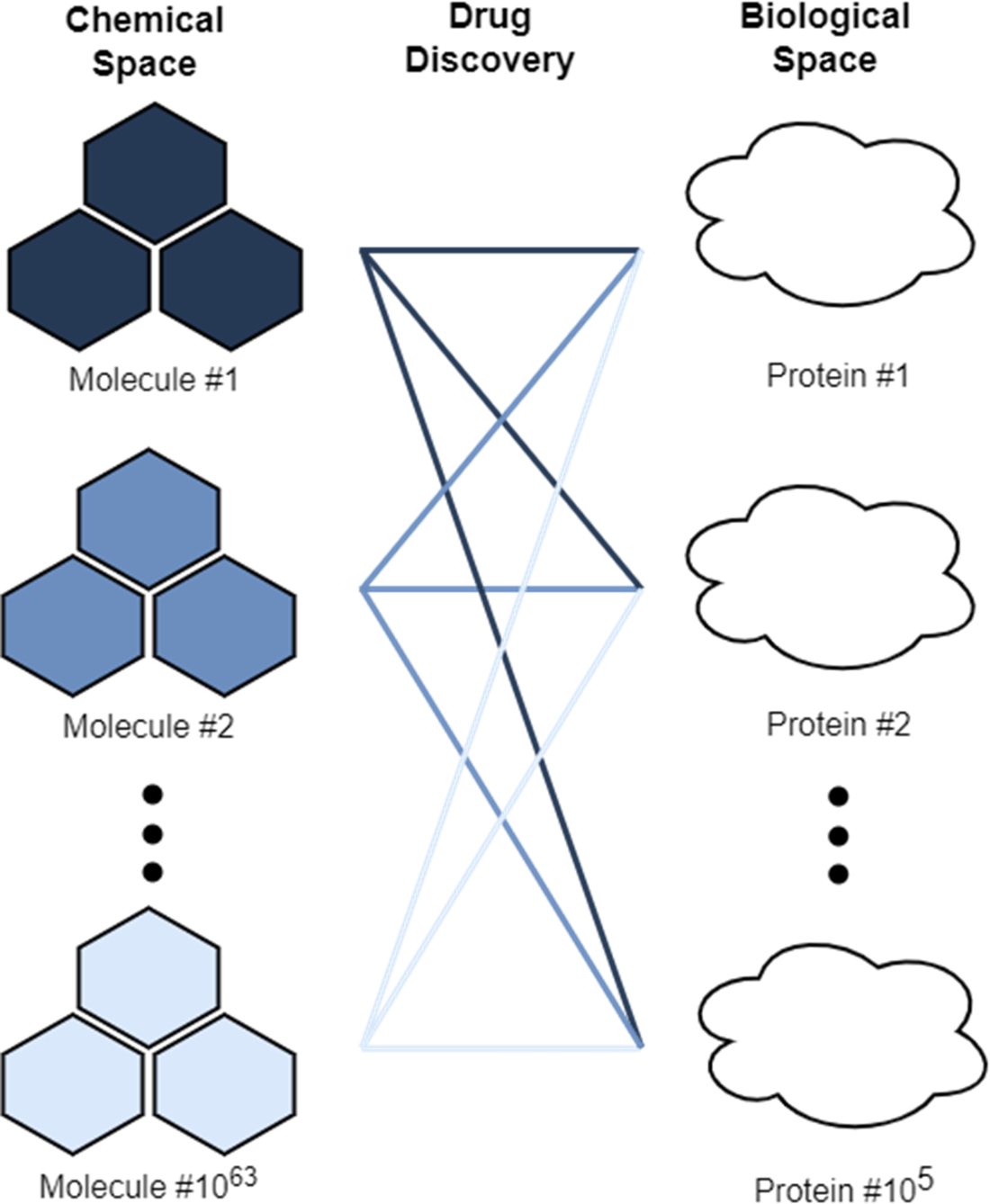
Maps drug discovery to the intersection of the chemical search space of drug-like compounds and the biological search space of targets. section 1.1.1
