Chemical space is the set of possible chemical structures and compounds considered in a search. In drug discovery, it often refers to possible drug-like molecules. Estimates vary, but one puts their number at around 10⁶³—far too many to synthesize and test exhaustively. section 1.1.1 section 10.1.1
The practical goal is usually not to test every molecule against every biological target. A team often starts with a target, such as a protein, and searches for a compound that affects it. Both the molecule and the target can adopt different three-dimensional shapes, which adds difficulty to predicting their interaction. section 1.1.1
Different approaches navigate chemical space in different ways:
- High-throughput screening tests large libraries of existing compounds, but is costly and limited by the diversity of available libraries. section 10.1.1
- Structure-based design uses knowledge of a target, such as a protein's three-dimensional structure. It can involve slow, iterative design, synthesis, testing, and analysis. section 10.1.1
- Generative models learn a compressed molecular latent space: a simplified map used to explore and design new molecules. A variational autoencoder aims to make this map continuous enough to sample for novel molecules. section 10.0 section 10.5
Finding a molecule that acts on a target is only a start. A candidate may also need suitable solubility, low toxicity, and desirable pharmacokinetic properties. A basic autoencoder illustrates another pitfall: reconstructing familiar molecules accurately does not guarantee that sampling its latent space will produce valid new ones. section 10.1.1 section 10.5
Chemical space also matters when planning how to make a molecule. Retrosynthesis works backward from a desired product toward simpler precursors. Each step can offer many possible transformations, making route selection a search problem of its own. section 1.3.3
Screening billions of candidates
A FADS1 inhibitor campaign considered a library of roughly 4.3 billion small molecules, with known ligands included as positive controls. Rather than test the entire library experimentally, a computational funnel used faster filters first and more demanding evaluations on progressively smaller candidate sets. section 13.3.2
Figure 13.8 Computational funnel architecture for billion-scale virtual screening with progressive accuracy-cost tradeoffs. Receptor.AI's FADS1 inhibitor discovery workflow reduces 4.3 billion candidates through four cascading filters with increasingly stringent evaluation: embedding-based screening (430:1 reduction ratio), parallel structure-based docking across 20 protein conformers (200:1 reduction), and ADMET profiling (500:1 reduction). The parallel docking layer exemplifies the workflow's computational pragmatism, screening 10M compounds against 20 structural variants (200M total predictions) remains tractable with DiffDock's 11.3× speedup over traditional methods, while attempting this scale with slower docking algorithms would be prohibitive. This staged architecture demonstrates how the modular AI components sketched in Figure 13.3 materialize into production pipelines that navigate the accuracy-throughput frontier at billion-compound scale.
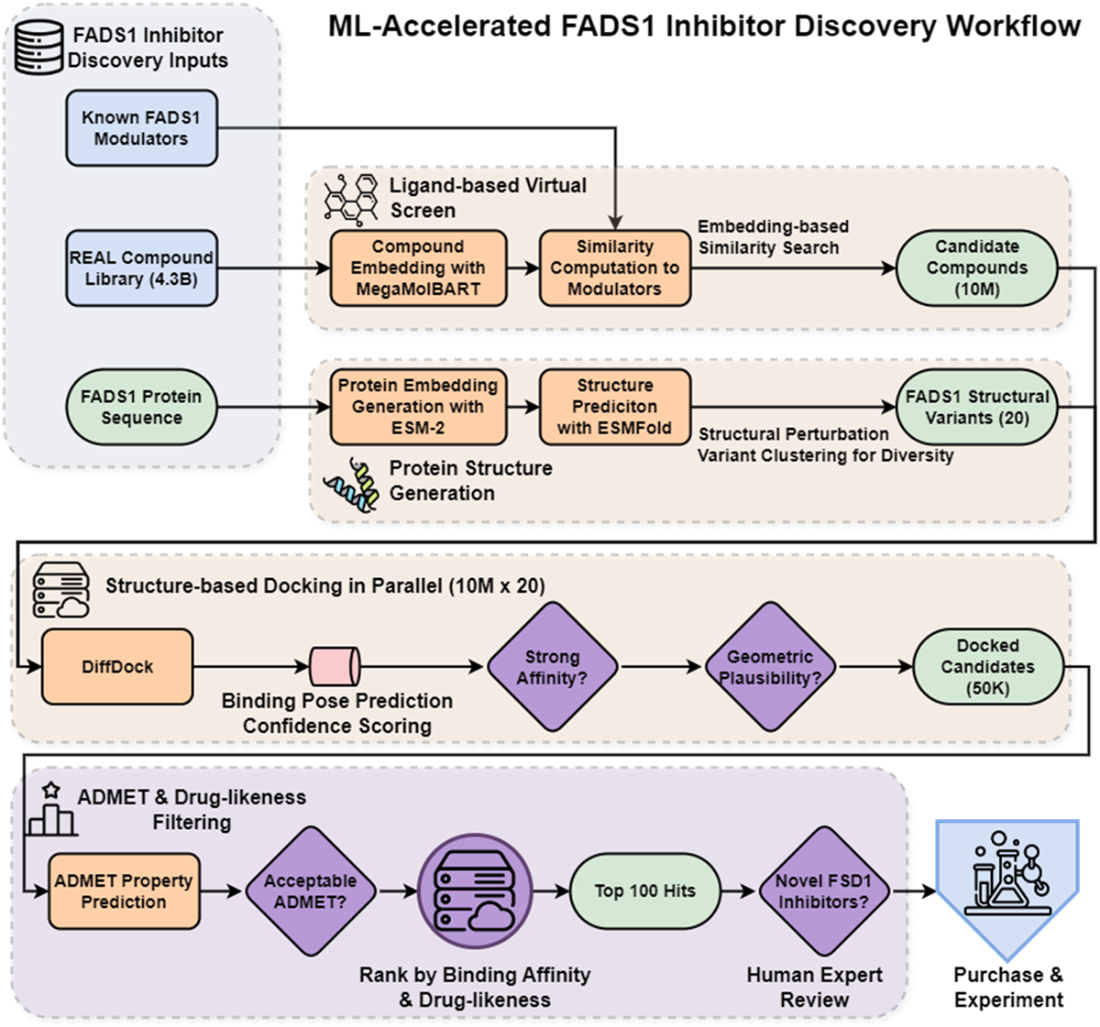
The screening funnel shows how successive filters trade computational cost against accuracy while narrowing a billion-scale library. section 13.3.2
