De novo drug design generates entirely new molecular structures from desired property criteria rather than selecting from an existing compound library. A generative model searches functional space—such as high solubility and low toxicity—and maps those requirements back to candidate structures in chemical space. section 1.3.2 section 10.1.1
Use the workflow with practical safeguards:
- Specify multiple requirements, including solubility, toxicity, pharmacokinetics, and therapeutic activity, rather than optimizing activity alone. section 10.1.1
- Distinguish de novo design from virtual screening: screening filters an existing molecular library, whereas de novo design generates structures from property criteria. section 1.3.2
- Treat predicted scores as provisional: weak property predictors can cause reward hacking, producing unstable, unrealistic, or unsynthesizable molecules. section 1.3.2
Figure 1.9 In virtual screening, we start with a large, diverse library of compounds that we can filter using a predictive model that has learned to predict what properties each compound has. Our predictive model has learned how to map the chemical space to the functional space. If the compound is predicted to have optimal properties, we carry it over for further experiments. In de novo design, we start with a defined set of property criteria that we can use along with a generative model to generate the structure of our ideal drug candidate. Our generative model knows how to map the functional space to the chemical space.
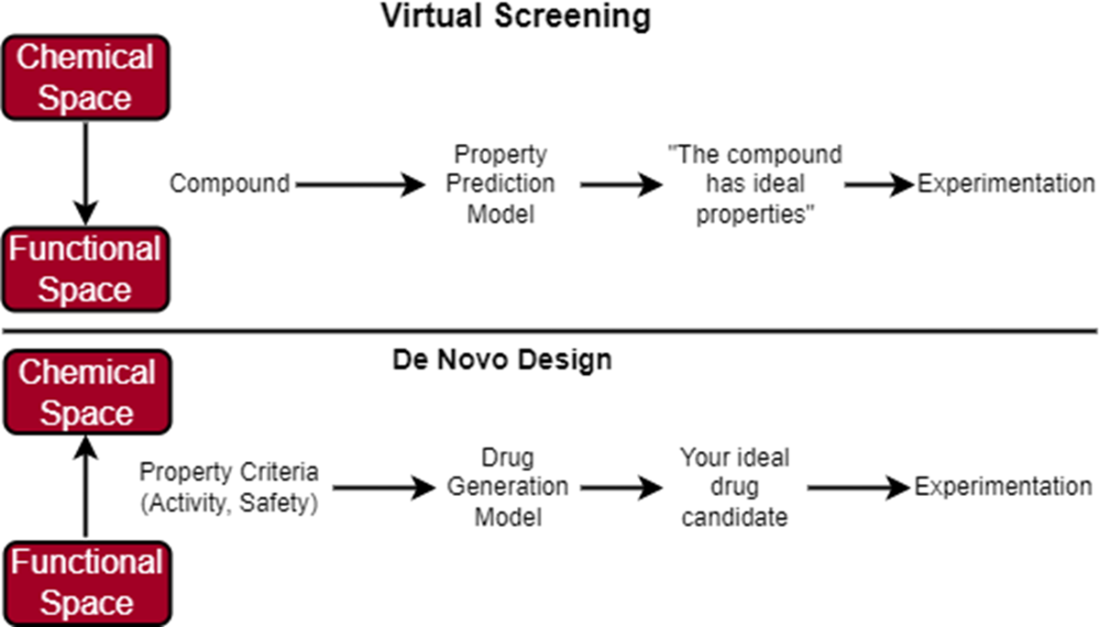
Compare virtual screening’s chemical-space-to-functional-space mapping with de novo design’s reverse mapping, and relate each approach to available ligand or target structures. section 1.3.2
