Virtual screening uses computational methods to prioritize compounds as potential drug candidates. It narrows a large chemical library to a subset for experimental testing, based on predicted target interactions or properties such as solubility and toxicity. section 1.3.1 section 2.0
The goal is enrichment: retrieving a higher proportion of active compounds early than random selection would. Virtual screening can assess compounds that have not yet been synthesized, but it relies on a computational model or rules rather than producing experimental measurements. section 2.0
A screening pipeline often starts with inexpensive methods and applies more demanding ones to a smaller set. Machine learning is one option, not a requirement; simpler methods also provide useful comparison points. section 2.1.1
A possible hierarchy is:
- Filter compounds for drug-likeness, structural alerts, or desired properties. section 2.1.1
- Use ligand-based screening, such as a pharmacophore or machine-learning approach, to narrow the library further. section 2.1.1
- Apply molecular docking to investigate binding in a target’s binding pocket, then molecular dynamics to a still smaller set. These stages are more computationally expensive. section 1.3.1 section 2.1.1
Figure 2.1 Virtual screening pipelines are often hierarchical, proceeding with a broad, large number of compounds through simpler, less restrictive, and computationally cheaper processes to whittle down the quantity of compounds. If the 3D structure of the target is not defined, we’re restricted to ligand-based virtual screening. If it is defined, then we can explore structure-based virtual screening, potentially as a downstream component to ligand-based virtual screening.
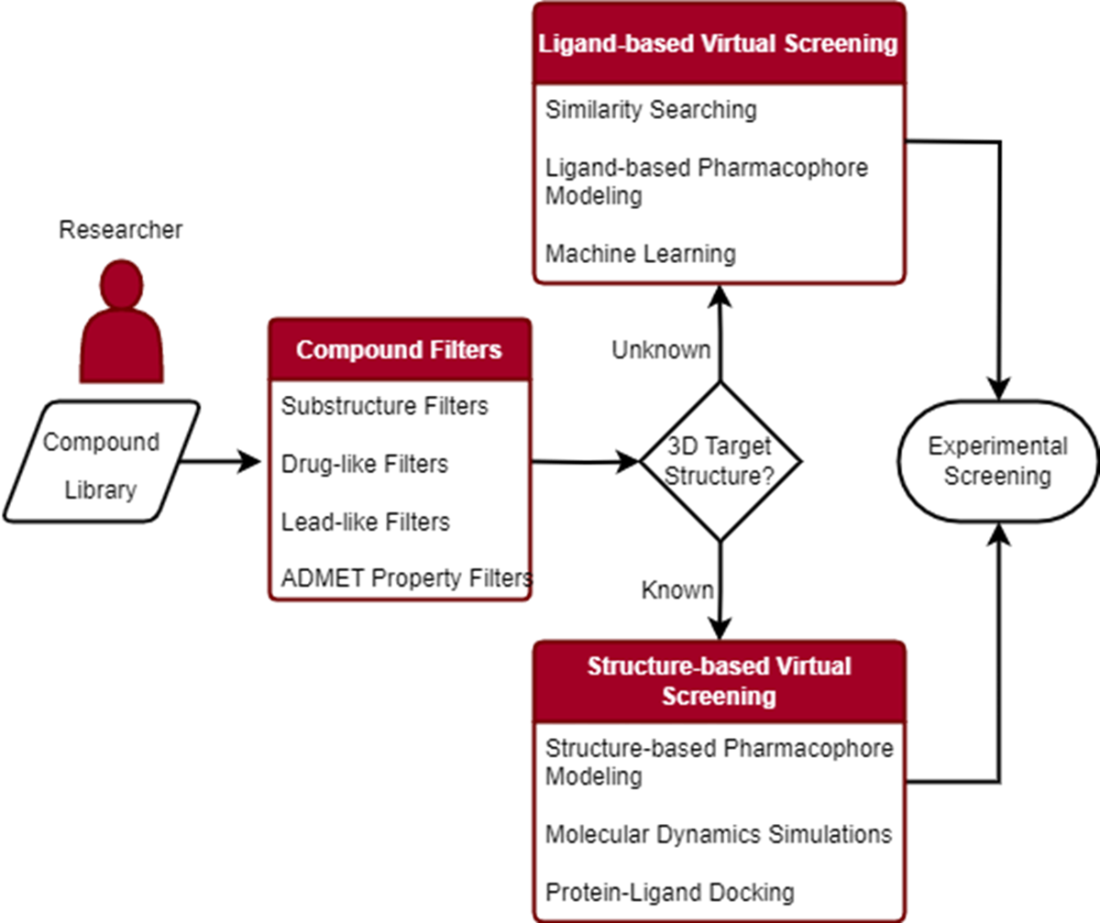
The pipeline diagram shows how screening stages narrow a library and how the availability of a target’s 3D structure affects the choice of strategy. section 2.1.1
The available data also guides method choice. In ligand-based screening, examples with and without the property of interest make classification with machine learning possible; when only positive examples are available, search-based strategies are more appropriate. section 2.1.1
Screening for desirable properties
To prioritize soluble, low-toxicity candidates, train a model using sufficient high-quality experimental data for those properties, then apply it to a candidate library. Such data is not always available, so the approach depends on checking the evidence before choosing a model. section 1.3.1
Finding potential antimalarial compounds
Compound filtering and similarity searching can be used to identify potential antimalarial hits. A separate machine-learning workflow for cardiotoxicity prediction illustrates data cleaning, molecular representation, model training, and evaluation. section 2.0 section 3.0
