A drug candidate is a compound advanced from preclinical work into clinical testing because its safety, efficacy, and development properties justify further evaluation. section 1.4 section 1.4.3
Drug candidates move through a staged discovery and development path:
- Target identification and validation establish a biological target. section 1.4
- Hit discovery, hit-to-lead, and lead optimization refine compounds with useful activity and properties. section 1.4
- Preclinical testing evaluates safety and efficacy in model organisms before human exposure. section 1.4.3
- Phase I examines safety, dosage ranges, and side effects; Phases II and III expand efficacy and risk-benefit evaluation in patients. section 1.4.3
Virtual screening for antimalarial candidates
A screening campaign can filter more than 212,000 purchasable small molecules for drug-like qualities and toxicity risk, producing candidates for downstream experiments against Plasmodium falciparum targets. section 2.1.2
Figure 1.11 We can breakdown drug design into target identification and validation, hit discovery, hit-to-lead (lead identification), lead optimization, and preclinical development. Once a drug candidate has progressed to the drug development stage, it will need to pass multiple phases of clinical trials testing safety and efficacy prior to submission to and review by the FDA and launch to market.
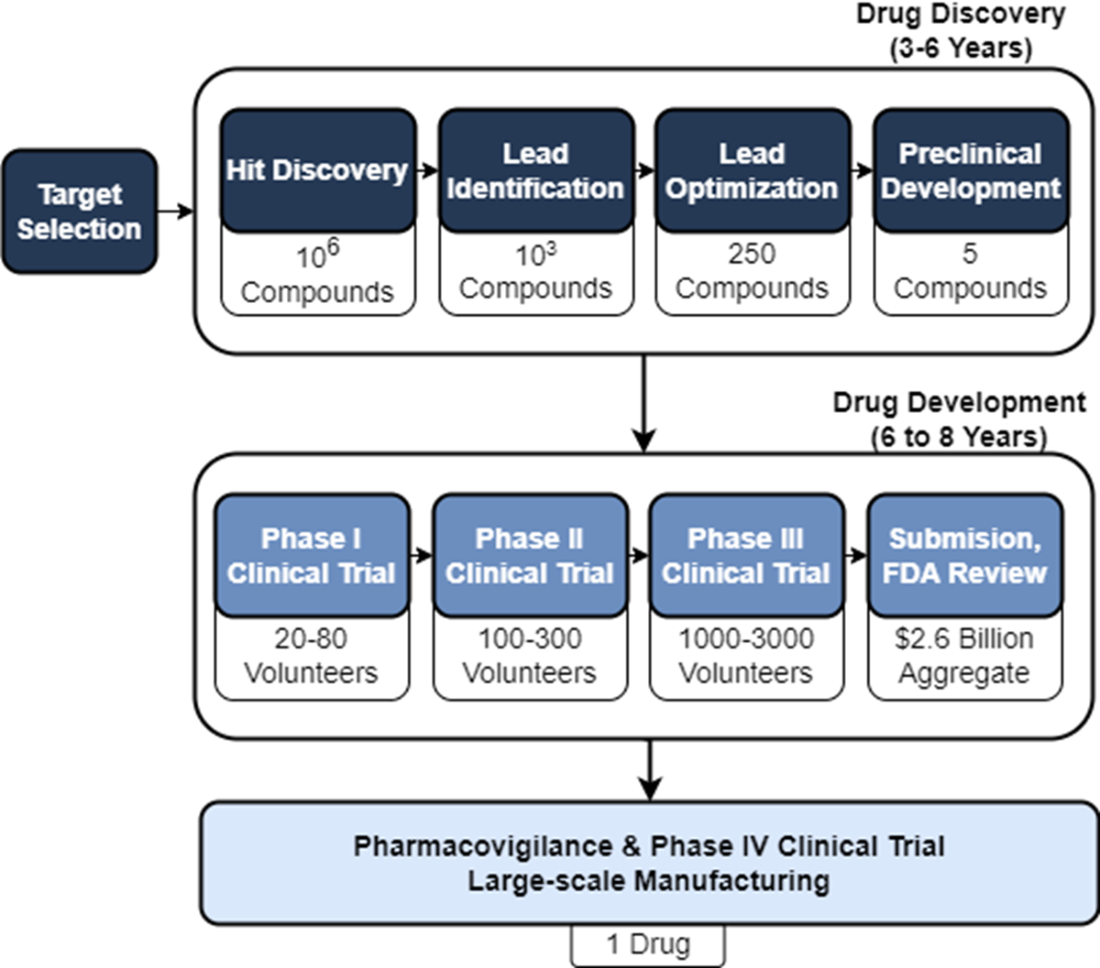
The process diagram connects target selection, hit and lead discovery, optimization, preclinical development, clinical trials, regulatory review, and market launch. section 1.4
