Lead optimization is the drug-discovery phase that modifies a promising lead compound while retaining its core molecular structure. The goal is to improve properties that determine whether it can advance toward preclinical study, especially potency, selectivity, developability, and safety. section 1.4.2 section 1.5
Optimization balances several related drug properties:
- Efficacy measures the maximum desired effect; potency measures the dose required to produce it, with lower required doses generally preferred. section 1.4.2
- Selectivity measures binding to the intended target relative to other proteins, while safety and therapeutic index describe the resulting risk profile. section 1.4.2
- ADMET covers absorption, distribution, metabolism, excretion, and toxicity; unfavorable PK, PD, or toxicity profiles increase clinical-trial failure risk. section 1.4.2
Active learning with free-energy calculations
After identifying promising hits, active learning can support lead optimization by using free-energy calculations to search for compounds with stronger binding affinity and reduced off-target activity. The appropriate computational oracle depends on the use case; docking is one possible earlier-stage technique. section 9.3
Figure 1.11 We can breakdown drug design into target identification and validation, hit discovery, hit-to-lead (lead identification), lead optimization, and preclinical development. Once a drug candidate has progressed to the drug development stage, it will need to pass multiple phases of clinical trials testing safety and efficacy prior to submission to and review by the FDA and launch to market.
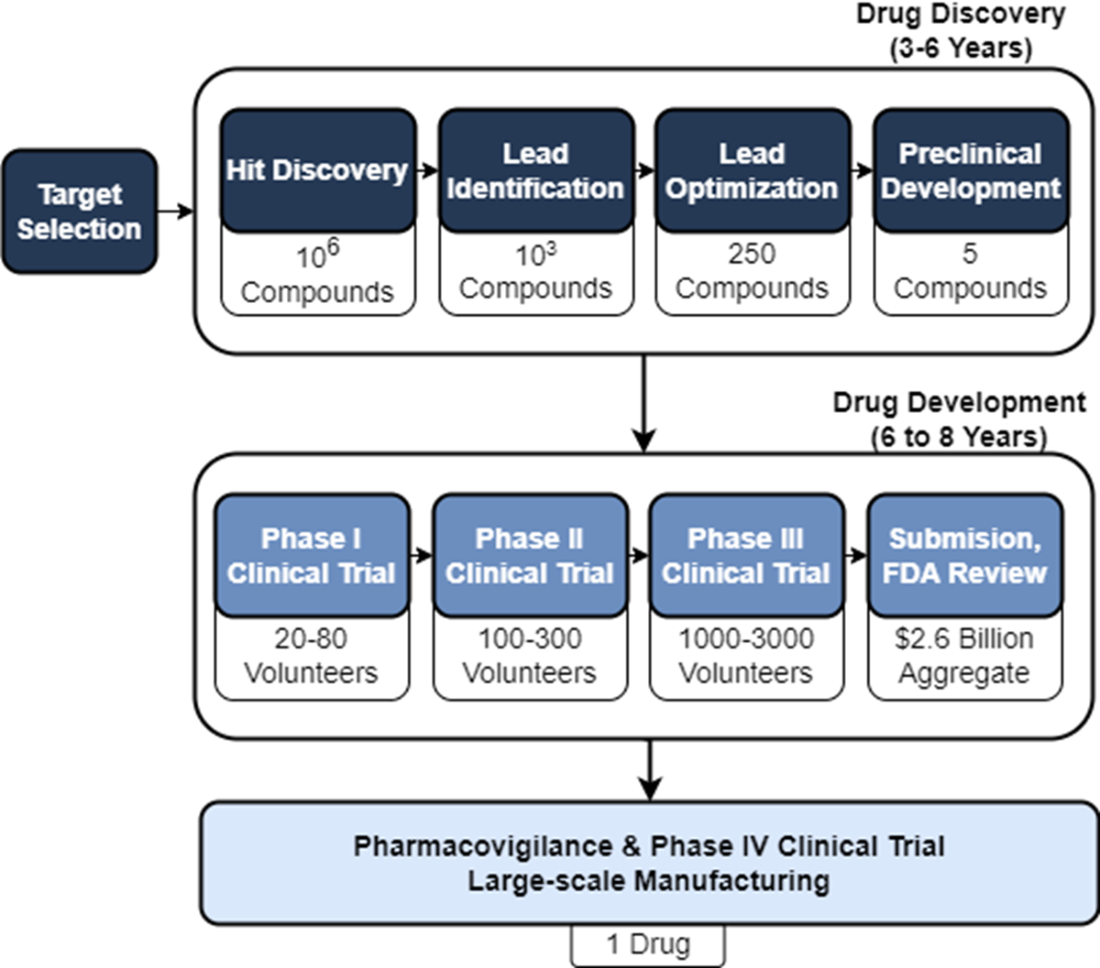
Use the pipeline diagram to place lead optimization between lead identification and preclinical development, followed by clinical testing for safety and efficacy. section 1.4
