Binding affinity measures how strongly a ligand associates with a biological target. In drug discovery, it helps identify candidate molecules worth prioritizing for experimental testing instead of searching the vast chemical space blindly. section 1.1.1 section 11.0
Interpret affinity through both molecular behavior and computational prediction:
- Treat binding as a physical interaction: flexible protein and ligand conformations adjust toward an arrangement that lowers the system’s overall free energy. section 1.1.1
- Predict drug-target affinity from paired molecule and protein representations, using molecular graphs and graph neural networks to capture connectivity, bonds, neighborhoods, and protein information. section 11.0
Kinase inhibitor discovery
For kinase inhibitors, strong affinity for the intended target is necessary but insufficient: the candidate must also remain selective across the broader kinase family. Computational affinity methods can make this expensive specificity assessment more tractable. section 8.1.1
Figure 11.1 Architecture of a Dual-Graph Model for Drug-Target Affinity Prediction. In section 11.1, we’ll familiarize ourselves with the problem of drug-target affinity prediction so we can better understand our objective for this chapter, why we need to work with both molecule and protein data inputs, why graph neural networks offer an advantageous approach over alternatives, and what benchmarks we’ll be using to guide model development. Section 11.2 and 11.3 detail how we can transform textual representations of molecules and proteins into rich, graph-based representations. In section 11.4, we’ll introduce the core learning engine, graph neural networks, that facilitate learning on graphs. Section 11.5 combines the previous sections to show the full DGraphDTA dual-stream architecture implementation, which we’ll train and later evaluate in section 11.6. The illustrated inputs (SMILES, protein sequence, experimental data) are based on a real result from [3] concerning development of a series of p38α inhibitors for rheumatoid arthritis.
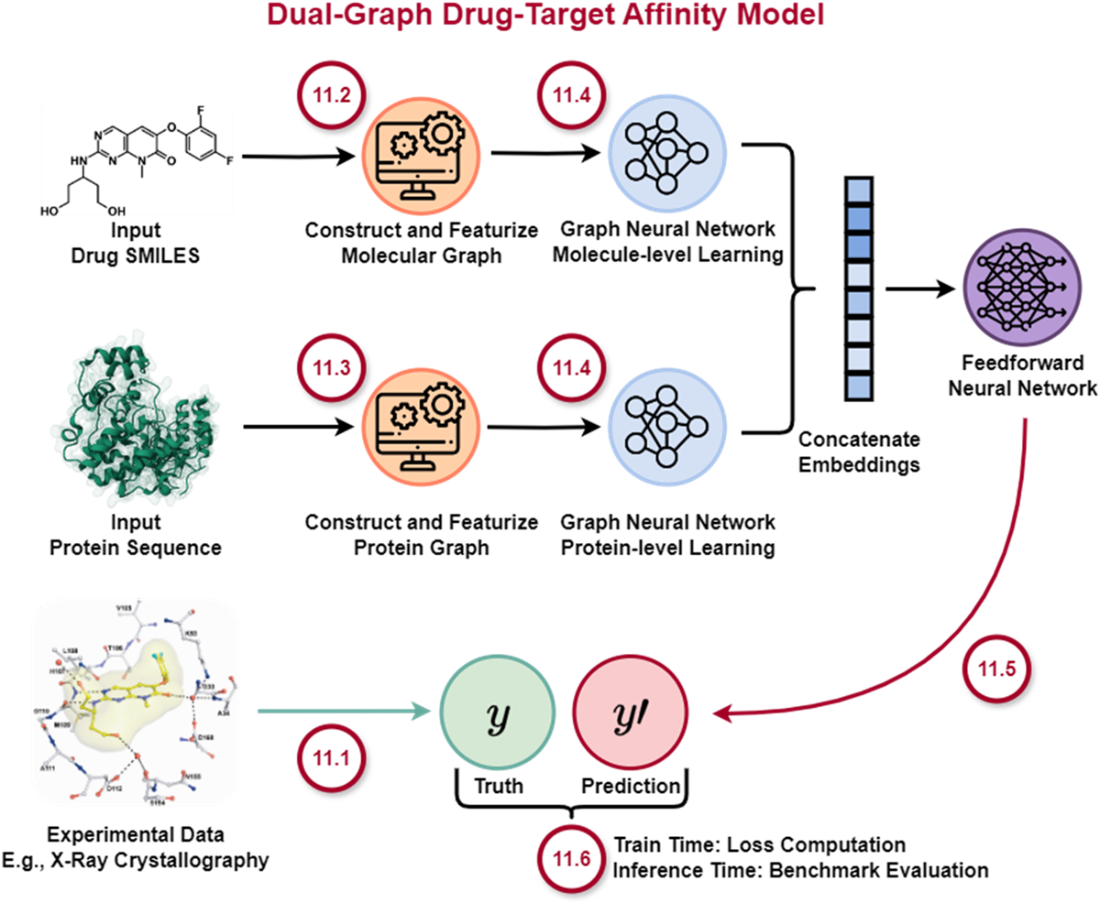
Follow the dual-graph architecture from SMILES and protein sequences through graph representations, message passing, training, and evaluation for drug-target affinity prediction. section 11.0
