Free energy perturbation (FEP) estimates how a structural change affects ligand binding affinity during lead optimization. It helps prioritize compounds for synthesis when docking is not accurate enough. section 9.3 section 9.3.1
FEP morphs one ligand into another and uses molecular-dynamics simulations to estimate the free energy of that transformation. A lower free energy indicates predicted stronger binding. Typical calculations achieve about 1 kcal/mol accuracy and require roughly 4–8 hours per molecule. section 9.3.1
A practical FEP experiment specifies:
- The receptor’s three-dimensional structure. section 9.3.1
- The ligand structure and its binding pose. section 9.3.1
- Force fields and molecular-dynamics simulation settings. section 9.3.1
- A transformation calculation that converts molecular motion and interatomic interactions into a binding free-energy estimate. section 9.3.1
Figure 9.8 Multi-stage active learning pipeline for structure-based lead optimization using free energy perturbation (FEP) calculations. The workflow begins with a large molecule library (10M-1B compounds) that is filtered down to 10K-1M molecules using machine learning ADMET models. From this filtered set, an initial sample of 500-1K diverse compounds undergoes medium-fidelity FEP evaluation (~1 day of computation). These results train a surrogate model that rapidly scores 10K-1M molecules to identify promising candidates. Based on these predictions, 500 molecules are strategically sampled for high-fidelity FEP analysis (1-2 days), resulting in approximately 10 synthesized hit molecules that advance to subsequent development stages. The diagram illustrates how computational resources (purple) are efficiently allocated to increasingly smaller but higher-quality compound sets (orange), enabling exploration of vast chemical spaces while concentrating expensive physics-based calculations on the most promising candidates.
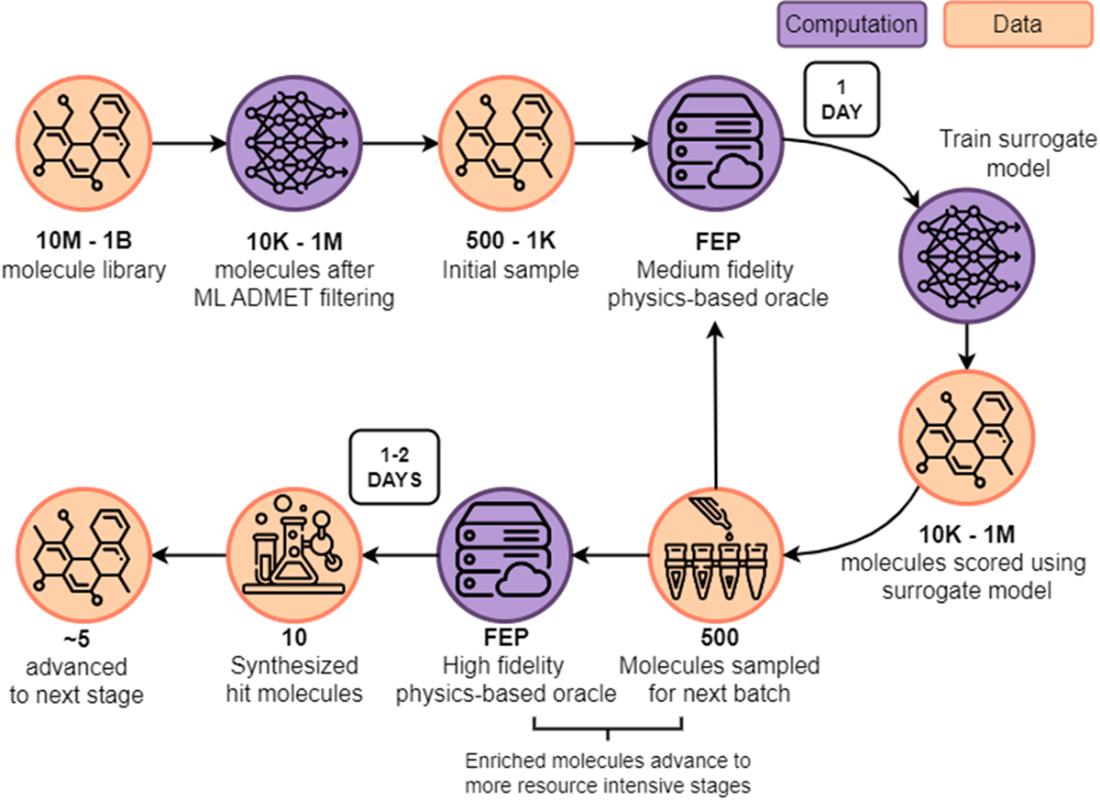
The workflow combines machine-learning filtering, diverse initial sampling, medium-fidelity FEP, surrogate modeling, and high-fidelity FEP to focus expensive calculations on promising compounds. section 9.3.1
Active-learning-guided FEP
A practical loop featurizes molecules, selects a diverse initial sample, runs free-energy calculations, fits a surrogate model, chooses the next molecule with an acquisition function, and repeats until the experiment budget is exhausted. A Gaussian process is preferred for small datasets. section 9.3.1
