An FEP protocol is the configuration that defines how a free-energy calculation transforms one ligand into another. It combines molecular inputs with physical models and simulation choices, so the resulting free-energy estimate can guide binding-affinity decisions. section 9.3.1
A protocol specifies:
- The receptor’s three-dimensional structure and the ligand’s bound structure or binding pose. section 9.3.1
- Protein and ligand force fields, plus the solvent model representing surrounding water. section 9.3.1
- Equilibration and production timescales, lambda values for gradual molecular transformation, and enhanced-sampling methods. section 9.3.1
- Treatments for variable structural elements, such as alternative protonation states or side-chain orientations. section 9.3.1
Figure 9.8 Multi-stage active learning pipeline for structure-based lead optimization using free energy perturbation (FEP) calculations. The workflow begins with a large molecule library (10M-1B compounds) that is filtered down to 10K-1M molecules using machine learning ADMET models. From this filtered set, an initial sample of 500-1K diverse compounds undergoes medium-fidelity FEP evaluation (~1 day of computation). These results train a surrogate model that rapidly scores 10K-1M molecules to identify promising candidates. Based on these predictions, 500 molecules are strategically sampled for high-fidelity FEP analysis (1-2 days), resulting in approximately 10 synthesized hit molecules that advance to subsequent development stages. The diagram illustrates how computational resources (purple) are efficiently allocated to increasingly smaller but higher-quality compound sets (orange), enabling exploration of vast chemical spaces while concentrating expensive physics-based calculations on the most promising candidates.
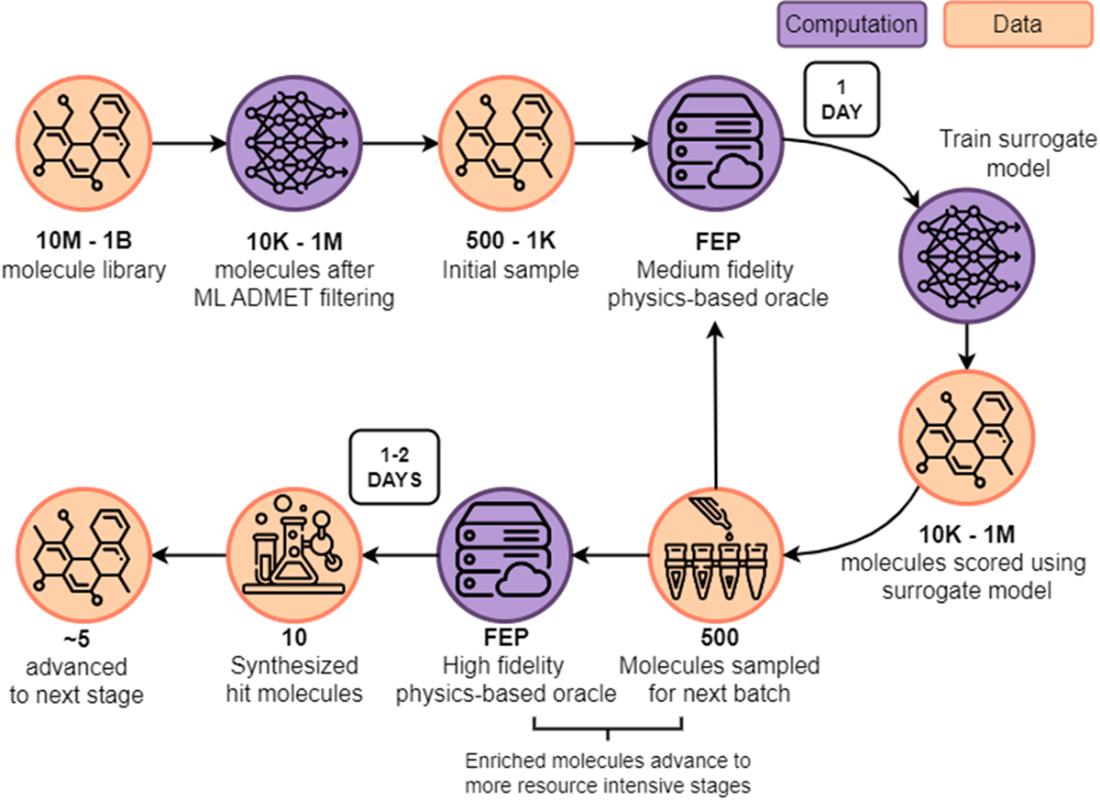
Use the workflow to see how different FEP fidelities allocate expensive calculations across progressively smaller compound sets. section 9.3.1
