A lead compound is a promising hit selected for further optimization and testing. Lead identification narrows many screened hits using biological activity, potency, and ADMET properties. section 1.4.2
Lead selection considers several practical properties:
- Efficacy measures the maximum desired effect; potency measures the dose required to produce it. section 1.4.2
- Selectivity measures binding to the intended target relative to other proteins and relates to potential safety. section 1.4.2
- ADMET covers absorption, distribution, metabolism, excretion, and toxicity, while PK describes what the body does to a drug and PD what the drug does to the body. section 1.4.2
- Lead optimization modifies a compound while retaining its core molecular structure to improve potency, selectivity, and ADMET properties. section 1.4.2
Figure 1.13 We can segment the early drug discovery pipeline into four main phases: target identification, hit discovery, hit-to-lead or lead identification, and lead optimization. Target identification designates a valid target whose activity is worth modulating to address some disease or disorder. Hit discovery uncovers chemical compounds with activity against the target. Lead identification selects the most promising hits and lead optimization improves their potency, selectivity, and ADMET properties to be suitable for preclinical study.
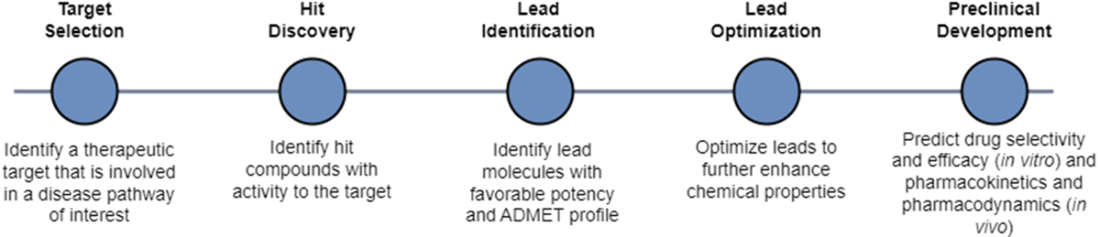
Use the early-discovery pipeline to place lead compounds between hit discovery and lead optimization, before preclinical study. section 1.4.2
From hits to leads
A discovery campaign may produce many active hits. In vitro assays, confirmatory assays, and ADMET screening narrow them to a smaller set of therapeutically useful leads for optimization and later testing. section 1.4.2
