ADMET describes how a drug compound behaves in a biological system: absorption, distribution, metabolism, excretion, and toxicity. These properties help determine whether a hit can become a viable lead. section 1.4.2
The five dimensions describe distinct stages of a compound’s interaction with the body:
- Absorption: entry into the bloodstream from an administration site, such as the gastrointestinal tract or respiratory system. section 1.4.2
- Distribution: movement through the body after entering the bloodstream. section 1.4.2
- Metabolism: enzyme-driven biochemical transformation, often producing more polar and water-soluble metabolites. section 1.4.2
- Excretion: removal of the compound and its metabolites from the body. section 1.4.2
- Toxicity: potential adverse effects on organs, tissues, or biological systems. section 1.4.2
ADMET screening helps narrow hits during lead identification and guides lead optimization alongside potency, efficacy, and selectivity. Unfavorable ADMET, pharmacokinetic, or toxicity profiles increase clinical-trial risk. section 1.4.2
Filtering a compound library
A virtual-screening workflow can first remove compounds with unfavorable ADMET properties or structural alerts before applying more expensive downstream analyses. Rule-based filters such as Lipinski’s Rule of Five provide a crude oral-drug-likeness screen, not a universal definition of drug-likeness. section 2.1.1
Figure 1.12 We can break down the ADMET properties into the following broad descriptions. Absorption refers to the process by which a drug enters the bloodstream from its administration site, such as the gastrointestinal tract for oral drugs or the respiratory system for inhalation drugs. Distribution pertains to the movement of a drug within the body once it has entered the bloodstream. Metabolism refers to the biochemical transformation of a drug within the body, primarily carried out by enzymes. Metabolic processes aim to convert drugs into more polar and water-soluble metabolites, facilitating their elimination from the body. Excretion involves the removal of drugs and their metabolites from the body. Toxicity assessment aims to evaluate the potential adverse effects of a drug candidate on various organs, tissues, or systems.
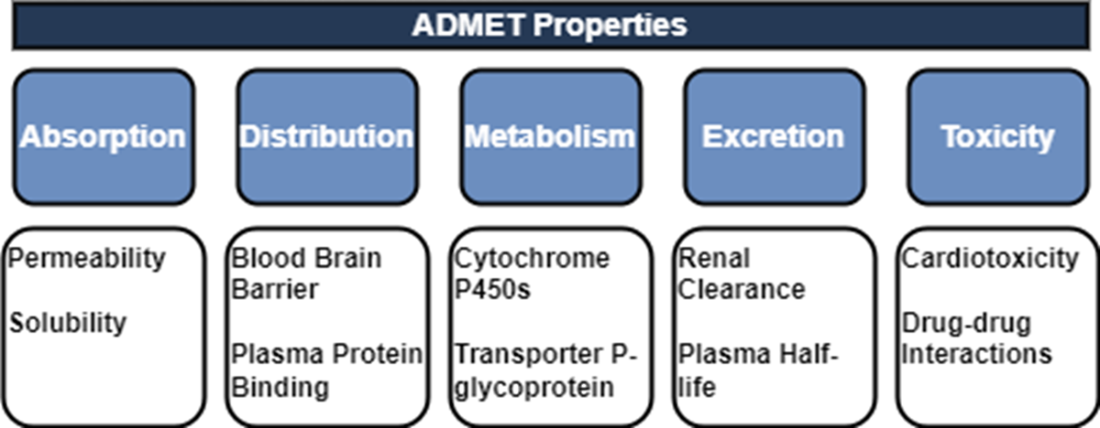
Use the diagram to compare the biological meaning of absorption, distribution, metabolism, excretion, and toxicity. section 1.4.2
