Molecular property prediction uses computational models to estimate chemical or biological properties from molecular structure. In drug discovery, it helps identify promising compounds before committing to expensive experiments. section 1.0 section 1.3.1
A machine-learning property-prediction workflow can:
- Take a compound and its structure as input, then predict whether it meets desired criteria such as low toxicity or high binding affinity. section 1.3.1
- Estimate properties such as solubility and toxicity when sufficient, high-quality experimental data is available for training. section 1.3.1
- Screen large compound libraries computationally, reducing the number of molecules requiring experimental testing. section 1.3.1
- Replace some expensive docking calculations with direct binding-affinity prediction for targets represented in the training data. section 1.3.1
Figure 1.8 Using AI to guide early prediction and optimization of drug-like molecules, we can broaden the number of considered candidate molecules, identify failures earlier when they are relatively inexpensive, and accelerate delivery of novel therapeutics to the clinic for patient benefit.
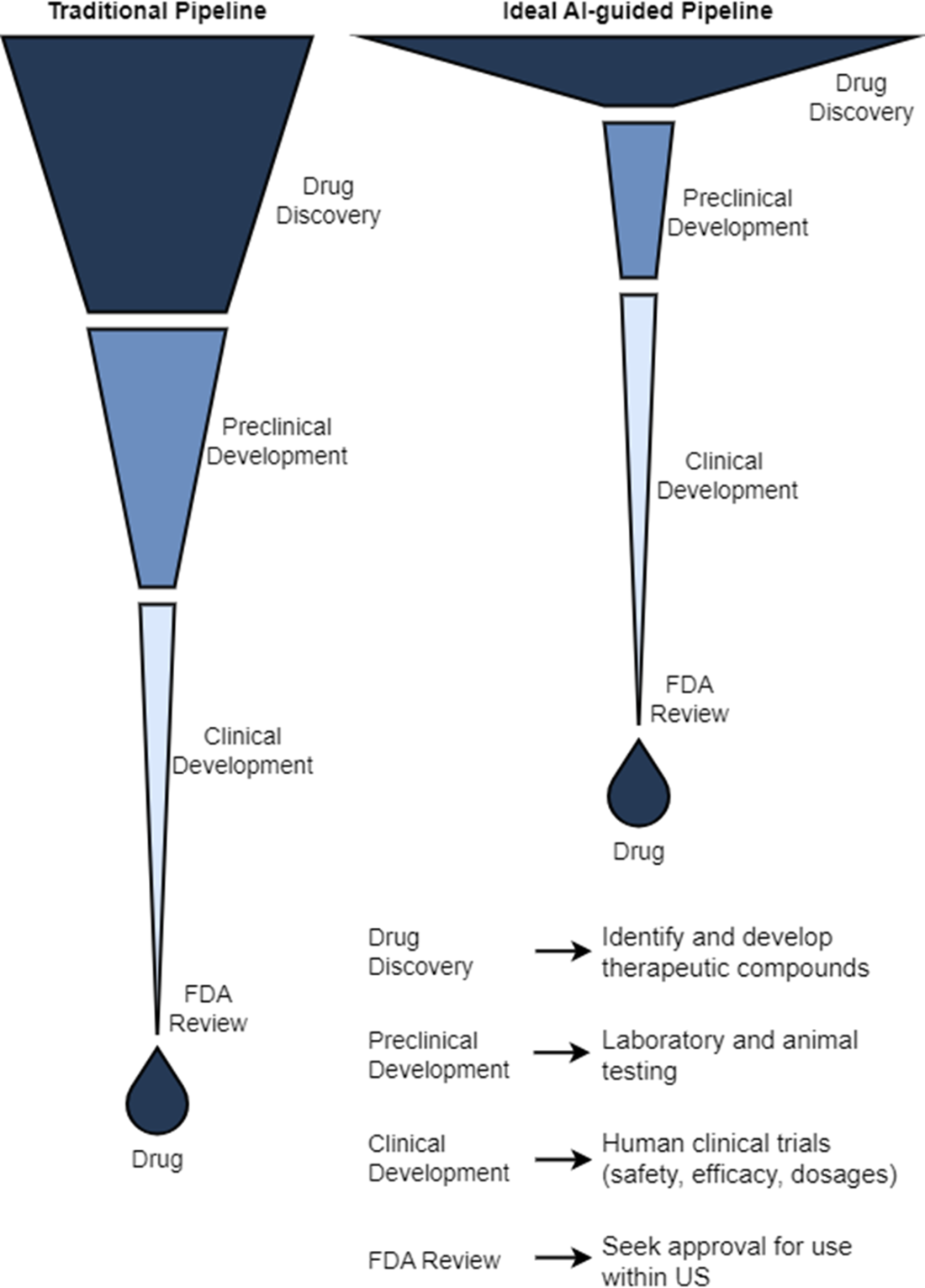
AI-guided early prediction and optimization can broaden the candidate set, expose failures sooner, and support faster therapeutic development. section 1.3.1
