Generative chemistry uses computational models to create novel molecular structures that satisfy biological, chemical, or medicinal requirements. In de novo design, the process starts with desired properties rather than an existing molecular library, addressing the difficulty of optimizing solubility, toxicity, pharmacokinetics, and therapeutic activity simultaneously. section 1.3.2 section 10.1.1
A generative chemistry workflow is framed around three ideas:
- Specify property criteria, such as high solubility and low toxicity, instead of beginning with a fixed compound library. section 1.3.2
- Use a generative model to map desired functional properties back to candidate structures in chemical space. section 1.3.2 section 10.1
- Score proposed molecules with property-prediction models, while checking for weaknesses such as instability, impractical synthesis, unrealistic structures, and reward hacking. section 1.3.2
Choosing a design strategy
When both a ligand structure and its target are known, structure-based design is available. Knowing only the ligand supports ligand-based design; knowing only the target can support de novo generation of a candidate. section 1.3.2
Figure 1.9 In virtual screening, we start with a large, diverse library of compounds that we can filter using a predictive model that has learned to predict what properties each compound has. Our predictive model has learned how to map the chemical space to the functional space. If the compound is predicted to have optimal properties, we carry it over for further experiments. In de novo design, we start with a defined set of property criteria that we can use along with a generative model to generate the structure of our ideal drug candidate. Our generative model knows how to map the functional space to the chemical space.
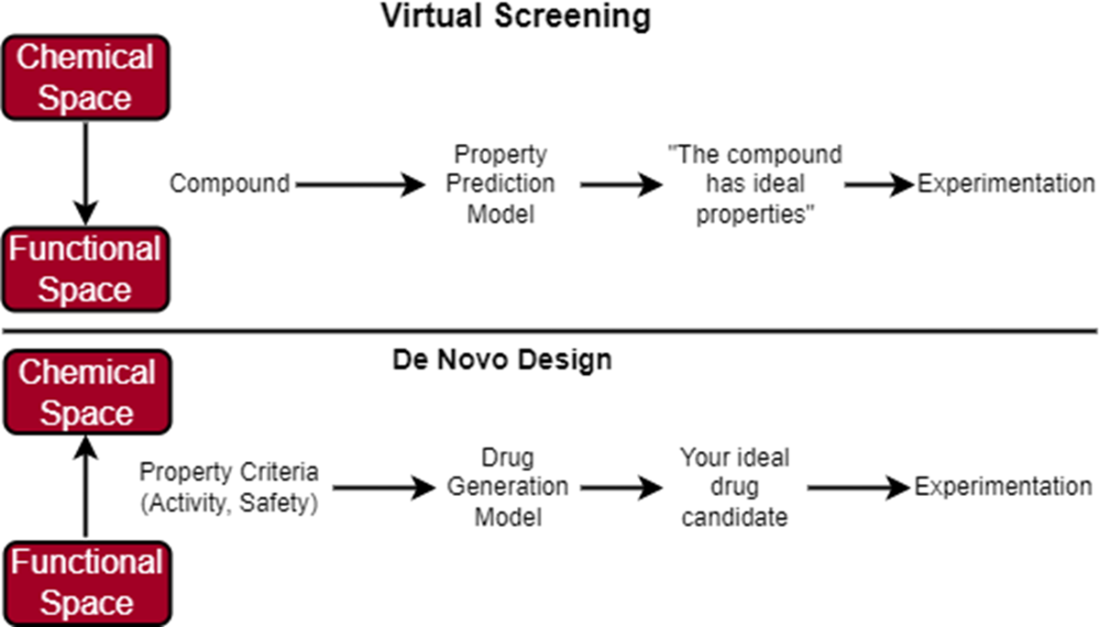
Compare virtual screening, which filters an existing chemical library, with de novo design, which uses property criteria to generate molecular structures. section 1.3.2
