Drug-target affinity prediction estimates how strongly a drug molecule binds to a biological target. It supports virtual screening by helping researchers identify promising compounds from large chemical libraries, reducing the time and cost of drug development. section 11.1
Traditional structure-based methods such as molecular docking and molecular dynamics depend on known three-dimensional protein structures. Sequence-based virtual screening instead predicts affinity from a target’s amino acid sequence when structural information is unavailable. section 11.1
Affinity prediction has developed from interaction detection toward quantitative estimation:
- Binary classification asks whether a drug-target pair binds or does not bind. section 11.1
- Regression predicts a continuous affinity value, commonly based on experimental Kd, Ki, or IC50 measurements. section 11.1
- Evaluation must account for dataset structure: mean squared error can favor the dominant weak-binding value, while Concordance Index evaluates whether affinity rankings are correct. section 11.1.1
DAVIS and KIBA benchmarks
DAVIS contains a sharp value-5 spike caused by an assay detection limit, aggregating weak and non-binding pairs. KIBA integrates heterogeneous Kd, Ki, and IC50 measurements into a more consistent bioactivity dataset with a more continuous target distribution. section 11.1.1
Figure 11.2 Distribution of pKd Affinity Values in the DAVIS Dataset and KIBA scores in the KIBA Dataset. For the DAVIS dataset, we observe a very large, sharp peak visible at the y-value of 5, with a much smaller, broader distribution of values between 6 and 10.
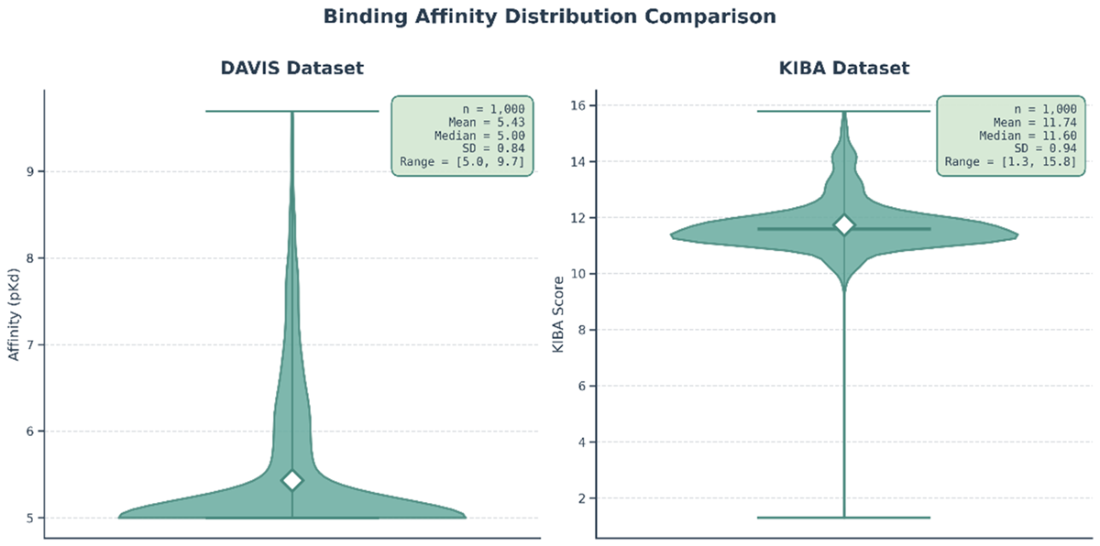
Compare the sharply concentrated DAVIS pKd distribution with the broader KIBA score distribution to see why dataset characteristics affect evaluation. section 11.1.1
