Dynamic ARP Inspection (DAI) protects Cisco switch networks from ARP poisoning by inspecting ARP messages and filtering forged IP-to-MAC mappings. ARP poisoning can redirect LAN traffic to an attacker; Port Security and DHCP Snooping alone do not stop it. section 14.0 section 14.3
DAI permits every ARP message received on a trusted port. It inspects messages received on untrusted ports, checking Sender MAC and Sender IP against the DHCP Snooping binding table; matching entries are forwarded and unmatched entries are discarded. All ports are untrusted by default, so end-host ports normally remain untrusted while router and switch links are trusted. DAI affects ARP messages only. section 14.2.1 section 14.3
Configure and verify DAI with these Cisco IOS operations:
- Enable DAI for one or more VLANs globally: ip arp inspection vlan 1 or ip arp inspection vlan 2-5,7,9,2028. section 14.2
- Trust an infrastructure-facing interface with ip arp inspection trust; leave end-host interfaces at their untrusted default. section 14.2.1
- Verify VLAN state with show ip arp inspection and interface trust and rate limits with show ip arp inspection interfaces. section 14.2 section 14.2.1
- Use an ARP access list with ip arp inspection filter when a permitted static IP-to-MAC mapping is not present in DHCP Snooping bindings. section 14.2.1
Basic Cisco IOS configuration
SW2(config)# ip dhcp snooping SW2(config)# ip dhcp snooping vlan 1 SW2(config)# ip arp inspection vlan 1 SW2(config)# interface g0/1 SW2(config-if)# ip dhcp snooping trust SW2(config-if)# ip arp inspection trust show ip arp inspection reports VLAN 1 as Enabled and Active. End-host interfaces such as Gi0/2 and Gi0/3 remain Untrusted, allowing DAI to inspect their ARP traffic. section 14.2 section 14.2.1
Figure 14.3 Configuring DAI. Note that a port can be untrusted by one feature but trusted by the other, as in SW1’s G0/2 case.
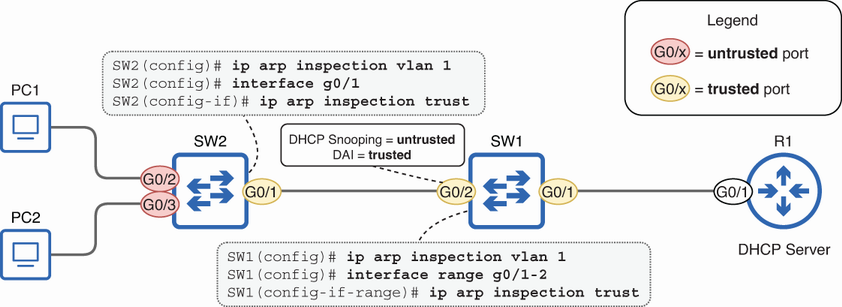
Use the configuration figure to compare DAI trust with DHCP Snooping trust; a port may be trusted by one feature and untrusted by the other. section 14.2
