A dynamic model represents financial decisions and resources across multiple periods. Today’s choices—asset allocation, spending, Social Security claiming, retirement, and account withdrawals—change the decisions available later, making the problem more complex than single-period optimization. section 6.0
Lifecycle models apply this framework across an individual’s or household’s life. Dynamic programming and reinforcement learning provide methods for optimizing these sequential wealth-management decisions, beginning with simple cases and extending toward more realistic ones. section 6.0
A dynamic financial model can incorporate:
- Multiple periods in which current decisions affect future choices. section 6.0
- Utility functions that compare outcomes under different spending and wealth paths. section 6.4
- Longevity risk, alongside investment risk, by allowing the date of death to be uncertain. section 6.4
Claiming Social Security
A 62-year-old can claim Social Security immediately or wait until 70 for a 76% higher payout. Present-value analysis gives only a small advantage to waiting, but a lifecycle model with utility and mortality risk produces substantially higher utility for delaying. Certainty equivalence translates that utility difference into approximately $35,000 of additional starting wealth for a person with relative risk aversion of 3. section 6.4
Figure 6.7 Quantifying the benefit of claiming Social Security at 70 vs. 62
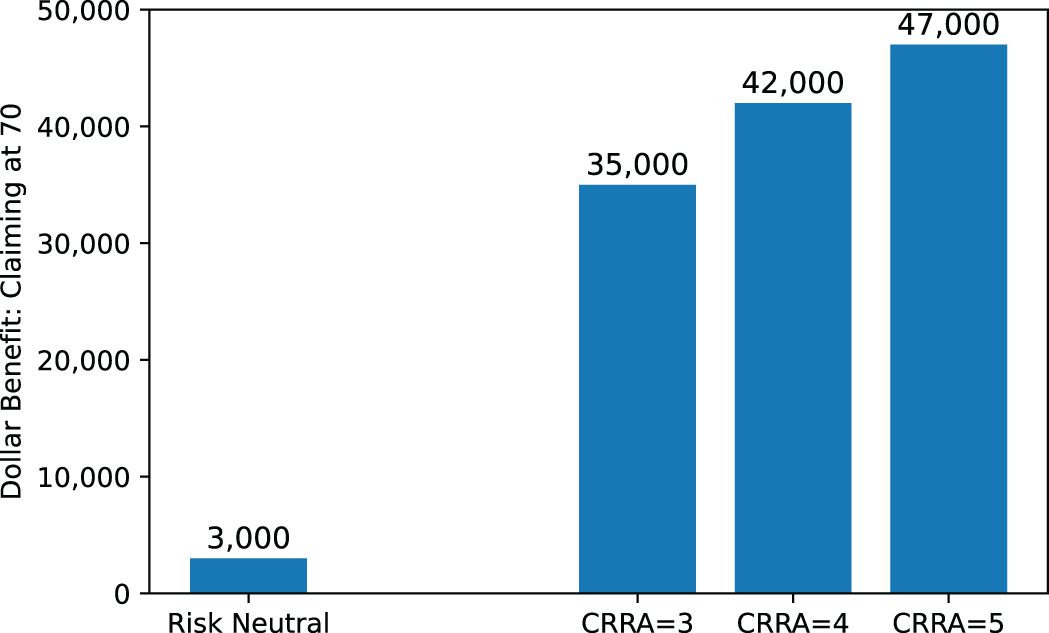
Compare the modeled value of claiming Social Security at age 70 with claiming at age 62. section 6.4
