Neural relational inference (NRI) predicts how interacting entities move while inferring which entities interact. It is useful when observations arrive over time but the interaction network is partly or entirely unknown. Unlike a temporal-only RNN or a graph model that collapses time into one graph, NRI combines relational and temporal learning. section 6.4 section 6.4.3
Think of each observed frame as node data for a changing graph:
- Encode the node data into a probability distribution over latent edge types. In a body-pose example, the two types are connected and not connected. section 6.5.3
- Sample edges from that distribution and use a decoder with recurrent memory to reconstruct subsequent graph states and node trajectories. section 6.4 section 6.5.3
- Train against the next observed states using a reconstruction term and a KL-divergence term. For longer forecasts, encode the observed frames, then run the decoder forward without teacher forcing. section 6.4
Figure 6.11 Schematic for NRI (Source: Kipf et al. [2]). The model consists of an encoder and decoder layer and several message-passing steps. However, here the messages are passed in the encoder from node to edge, back from edge to node, and then back from node to edge again. For the decoder, messages are passed from node to edge and then from edge to node. The final step takes the latent representation and is used to predict the next step in the temporal evolution of the body.
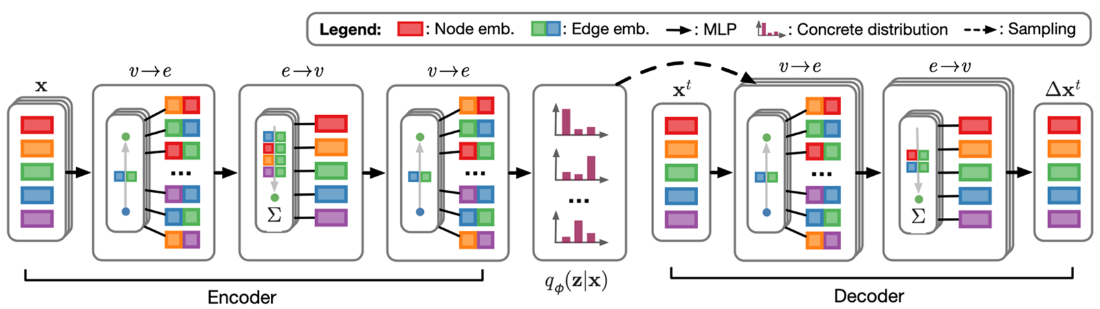
The schematic traces message passing between nodes and edges in the encoder and decoder, then shows how the latent representation produces a future step. section 6.4
Predicting a walking pose
Treat joint sensors as nodes and body connections as edges. Given earlier poses, predict later sensor positions. On the reported test, NRI reached an MSE of 0.00008 for the next timestep and 94% accuracy at 40 timesteps, versus 65% for an LSTM and 55% for a GAT. Accuracy still decreased as the forecast extended. section 6.6 section 6.4.3
The same joint inference matters beyond poses: moving particles or players may interact only under conditions that are not supplied as graph edges. The two-edge-type pose setup is a starting point, not a requirement; more interaction types are possible. section 6.4.3 section 6.5.3
