Early stopping halts iterative training when validation performance stops improving for a chosen number of iterations. It limits unnecessary optimization, helping gradient-boosted decision trees avoid overfitting while reducing the cost of adding more trees. The same idea also applies to neural-network training. section 5.3.1 section 5.2.1
Set aside part of the training data as a validation set, then evaluate each partial model on a chosen metric. Record the best validation result. Reset the patience counter after an improvement; otherwise increment it. Stop once the counter reaches its limit, or when the maximum planned number of iterations is reached. Training error commonly keeps falling while validation error reaches a favorable point and can then worsen. section 5.3.1
Figure 5.8 A process flow chart describing how early stopping works in GBDTs
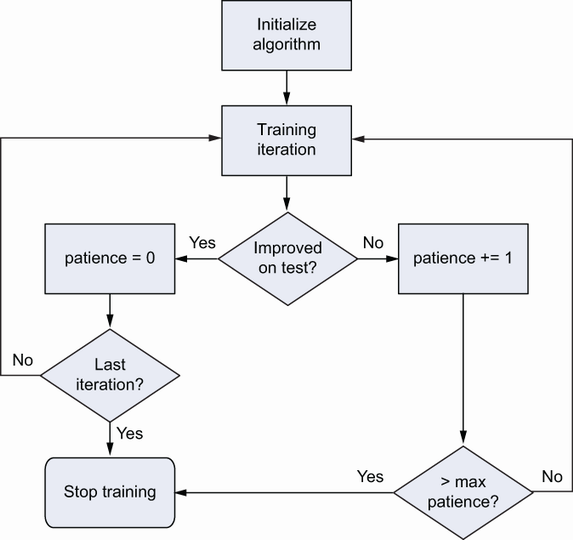
Use the flow chart to follow the validation check, patience count, and stop-or-continue decision at every boosting iteration. section 5.3.1
Choose the stopping setup deliberately:
- Validation fraction reserves training examples for monitoring. In a GradientBoostingClassifier, validation_fraction=0.2 supplies that held-out portion. section 5.3.1
- Patience determines tolerated non-improving iterations. Scikit-learn uses n_iter_no_change; XGBoost uses early_stopping_rounds; TabNet uses patience. section 5.3.1 section 5.4.4
- Evaluation metric determines what counts as improvement. XGBoost can use default or selected metrics, and its eval_set identifies the data monitored during fitting. section 5.4.4
- LightGBM callbacks can tighten the rule with min_delta and select whether only the first metric is considered. section 5.5.3
Stopping a tabular-data boosting run
For a GradientBoostingClassifier, allow up to 1,000 trees but reserve 20% of the training data and stop after 10 non-improving iterations. In the illustrated cross-validation run, early stopping selected substantially fewer trees across folds and reduced mean fit time from 16.48 to 6.24 seconds while the reported accuracy remained 0.826. Use a separate validation split when fitting XGBoost, pass it through eval_set, and let the recorded best iteration drive prediction. section 5.3.1 section 5.4.4
Early stopping complements, rather than replaces, other controls on model complexity. Tree-depth limits, leaf-size constraints, row or column subsampling, and pruning address the complexity of individual trees or the ensemble; early stopping decides when further boosting no longer benefits validation performance. Reserving validation data creates a trade-off: fewer examples remain for fitting, which can affect the final result. section 5.3 section 5.4.4
Implementations differ, but the operating pattern remains the same: monitor a held-out metric, wait through limited non-improvement, retain the best iteration, and stop. XGBoost automatically records and uses its best iteration at prediction time; LightGBM stores best_iteration and also uses it for prediction. A TabNet run can continue to its maximum epochs when validation accuracy never exhausts the configured patience. section 5.4.4 section 5.5.3 section 8.3.1








