ease-out is a CSS timing-function keyword for motion that starts quickly, then decelerates into its final value. It suits interfaces where an element should feel responsive without stopping abruptly. section 11.2.3
Its cubic Bézier curve is cubic-bezier(0, 0, 0.58, 1). Most of the change happens near the beginning, while the curve levels off toward the end like an object settling through friction. section 11.1.4 section 11.2.3
Use ease-out when:
- A modal should appear quickly and settle gently. section 11.4
- A button or menu should provide welcoming, responsive motion. section 11.2.3 section 11.4
- A transition should avoid the jump caused by delaying nearly all movement until the end. section 11.4
A settling transition
.element { transition: transform 1s ease-out; } The equivalent explicit curve is cubic-bezier(0, 0, 0.58, 1). section 11.2.3
Figure 11.9 The cubic Bézier curve defined by the ease-out keyword or cubic -bezier(0, 0, 0.58, 1)
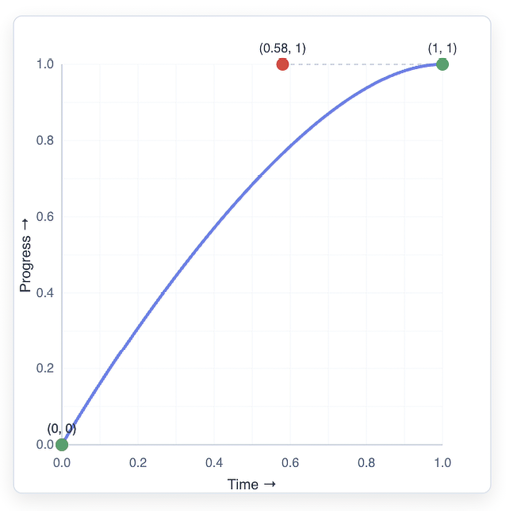
Inspect the ease-out curve to see its sharp initial rise and gradual leveling toward the final state. section 11.2.3
