Economies of scale are cost advantages that arise when larger operations reduce the average cost of providing goods or services. In cloud computing, providers can buy computing, storage, power, and network capacity in bulk, and design data centers to operate with fewer resources. section 4.2.5 section 1.1.1
These advantages are significant, but they do not apply equally to every organization:
- Smaller organizations may save on hardware and operating costs by using public-cloud infrastructure. section 4.2.5
- Large organizations may already buy at scale, own substantial infrastructure, or be able to convert virtualization investments into a cloud. section 4.2.5
- Private clouds often lack providers’ user volumes and operating experience, limiting their ability to match public-cloud costs. section 4.2.6
Comparing deployment costs
A small organization weighing a private data center against public cloud can compare upfront capital costs with ongoing operating costs. A large organization should also account for its existing hardware, purchasing relationships, and staffing capabilities. section 4.2.5 section 1.1.1
Figure 1.2. IT organizations have several alternatives for hosting applications. The choice of deployment model has different implications for the amount of CAPEX (up-front capital expenditure) and OPEX (ongoing operational costs). The number of $ signs represent the relative level of CAPEX and OPEX involved with the choice of deployment model.
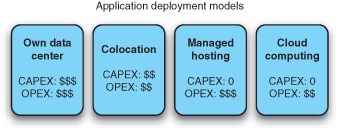
Compare the deployment models’ relative upfront capital and ongoing operating costs. section 1.1.1