Edge computing places workloads near the users, devices, or data sources that generate or consume them. It supports rapid responses, near-real-time insights, reduced central data transfer, and continued operation when cloud connectivity is unstable. section 8.2.2 section 7.0
Deploy edge infrastructure according to location and responsibility:
- Telco edge uses operator data centers, points of presence, and network cabinets. section 8.2.2
- Public cloud edge uses provider or broadcaster points of presence and CDN edges. section 8.2.2
- Enterprise edge places smaller infrastructure in branch offices, retail stores, warehouses, and factories. section 8.2.2
- Expect a growing compute fleet and provide a central management plane capable of managing tens of thousands of nodes. section 8.2.2
Edge architectures keep latency-sensitive processing close to endpoints while sending non-real-time analytics, metadata processing, or model training to the cloud. Containerized workloads and Kubernetes-consistent platforms support this split across distributed sites. section 8.2.1 section 7.0
Smart retail queue management
A store camera streams checkout video through a 5G modem to a telecom edge location. An Anthos bare metal cluster runs a containerized machine-learning application that counts people in line and sends a request to open another register when a threshold is exceeded. Event metadata goes to Google Cloud for analytics and future model training, while video inference remains at the telecom edge. section 8.3.3
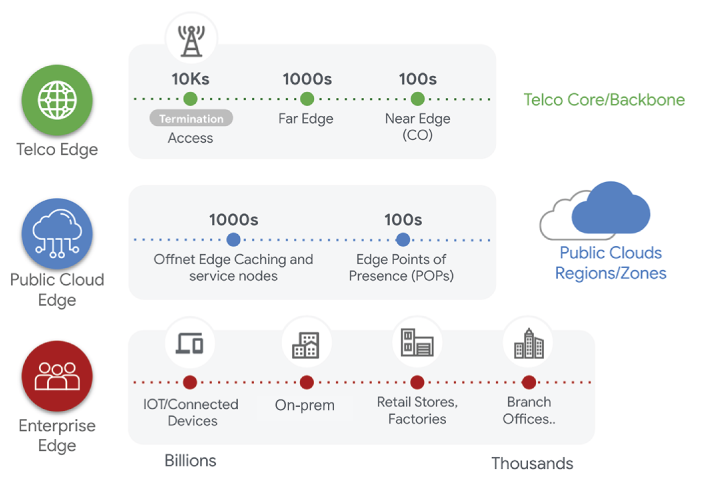
Compare telco, public cloud, and enterprise edge placements and their distributed infrastructure roles. section 8.2.2
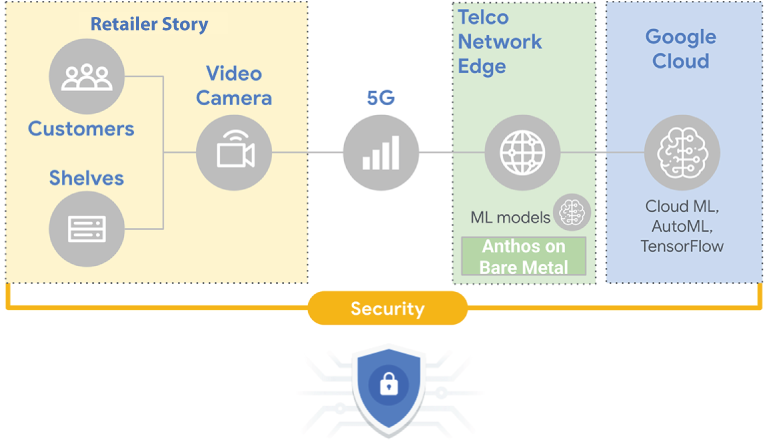
Trace the smart retail path from camera and 5G transport through telecom-edge inference to cloud analytics. section 8.3.3




