An edge list represents a graph as records containing the endpoint nodes of each edge. For molecular graphs, it stores bonded atom pairs and avoids the mostly empty space of an adjacency matrix. section 11.2.1
A molecular edge list can support graph neural network processing by:
- Recording each chemical bond as a pair of atom indices. section 11.2.2
- Adding reverse edges because chemical bonds are undirected but many GNN formulations use directed graphs. section 11.2.2
- Adding self-loops so neighborhood aggregation can retain each node’s own features. section 11.2.2
- Pairing connectivity with atom features such as element, degree, hydrogens, valence, aromaticity, and charge. section 11.2.1 section 11.2.2
SMILES-to-graph conversion
A practical conversion parses a SMILES string with RDKit, validates the molecule, extracts atom features and bonds, converts the bonds into directed edge pairs, and adds self-connections for graph processing. section 11.2.2
Figure 11.3 Graphs contain multitudes. Aspirin represented as a graph across multiple formats: 1) 3D ball-and-stick model, 2) Graph representation with nodes and edges, 3) Adjacency matrix representation, 4) Edge list representation.
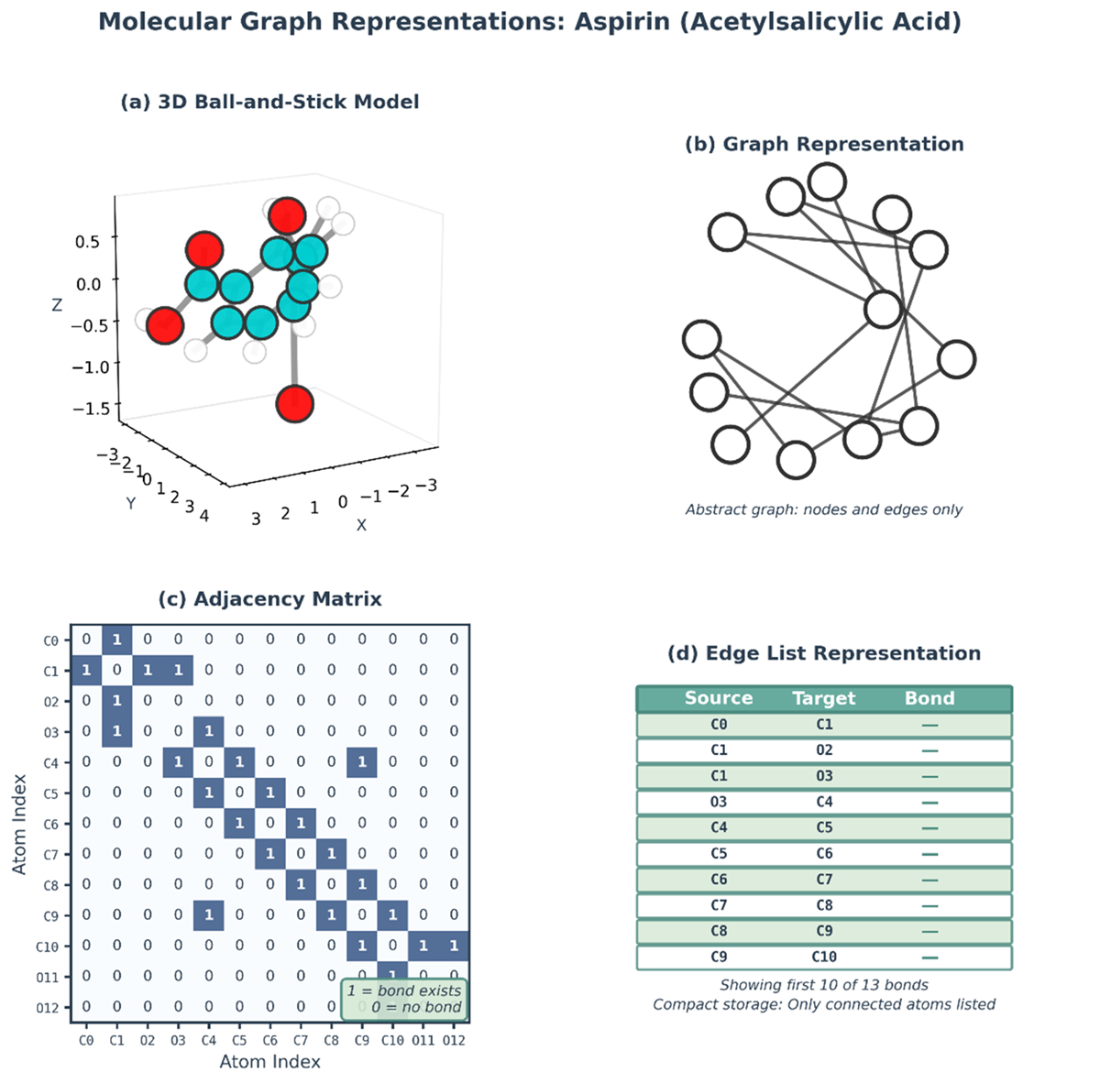
Compare aspirin as a molecular model, graph, adjacency matrix, and edge list to see how the same connectivity is represented. section 11.2.1

