An elliptic curve is an equation whose points support number-like algebra. For cryptography, the useful setting is a finite field: points satisfying the curve equation can be added and multiplied, while recovering the underlying relationship between selected points is intended to be infeasible at suitable sizes. This gives public-key systems comparable security with smaller numbers than RSA-style methods, reducing memory, processing, FPGA gates, or GPU resources. section 1.2 section 1.5
A real-number plot supplies an intuitive model before the arithmetic moves to finite fields. For example, y² = x³ − 5x + 5 draws a familiar-looking curve in the (x, y) plane. The visual shape is only a guide: finite-field points obey the same formulas but do not form a smooth plotted line. section 3.0 section 3.1 section 3.1.2
Point algebra is built from a few operational rules:
- Add distinct points P and Q by drawing their line, locating its further curve intersection, and taking the point reflected to the opposite side. section 3.1
- Treat the point at infinity as the additive identity: P + 0 = P and R − R = 0. It is off the graph and requires explicit code handling. section 3.1
- Build point multiplication from repeated point addition, using curve and point structures plus routines for the required operations. section 3.2
Finite fields determine how curve coordinates are manipulated. A geometric picture can also connect finite-field curves with curves on the complex plane: repeating values can be viewed on a torus, with cyclic vectors marking a grid that maps to a finite field. The connection motivates why point-addition rules carry across real, complex, and finite fields; cryptographic use here focuses on fields based on large primes. section 3.1.2
A toy curve modulo 43
The curve y² = x³ + 23x + 42 mod 43 has 54 finite points; including the point at infinity gives group order 55. Enumerating its points exposes differing point orders: 4 points have order 5, 10 have order 11, and 40 have order 55. Selecting a base point of prime order, such as 11, avoids mixing with points of other orders. The example uses curve initialization, point embedding, brute-force order calculation, and a file of discovered points. section 13.3 section 13.3.2
Figure 3.1 Elliptic curve \(y^2=x^3-5 x +5\)
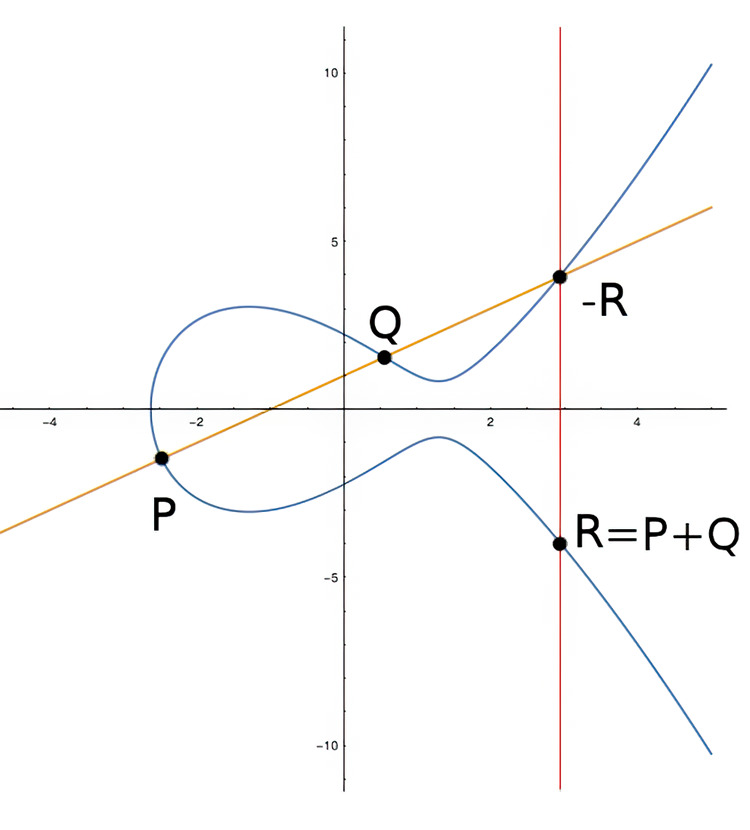
Use the plotted real-number curve to see the line-and-reflection model behind point addition before applying the same rules to finite-field coordinates. section 3.1
This algebra underlies key exchange and digital signatures. Pairings extend the setting: points on a base curve and a field-extension curve can produce a field-extension value, enabling aggregate signatures and compact zero-knowledge-proof constructions. Pairing work depends on curves with the relevant group structure, including two cyclic groups in the field-extension setting. section 1.2 section 3.1.2 section 1.5