An elliptic curve is a mathematical curve defined by an equation such as y² = x³ + ax + b. Its special point operations support cryptography without requiring developers to work through the underlying equations. section 1.3 section 10.1.1
Adding points geometrically keeps results on the curve; repeatedly multiplying one point creates a result that is easy to calculate forward but difficult to reverse. This one-way behavior supports secure key exchange. section 7.1.1 section 10.1.1
Choose an approved named curve rather than inventing one:
- Curve25519 emphasizes speed and security and is commonly used in secure messaging. section 7.1.1
- Curve448-Goldilocks provides a higher stated security level, while P-256 is widely standardized. section 7.1.1
- All communicating parties must use the same curve, and selection balances security level with computational efficiency. section 7.1.1
Elliptic curves in TLS
During TLS, two parties use ECC to generate the same shared secret without sending that secret across the network. An observer sees the exchange but cannot feasibly recover the private values. section 10.1.1
Figure 10.6 Curve25519 is an elliptic curve that’s widely used in secure communication systems like WhatsApp and Signal. Its equation provides both high security and efficient performance, making it ideal for modern encryption on low-powered devices such as smartphones.
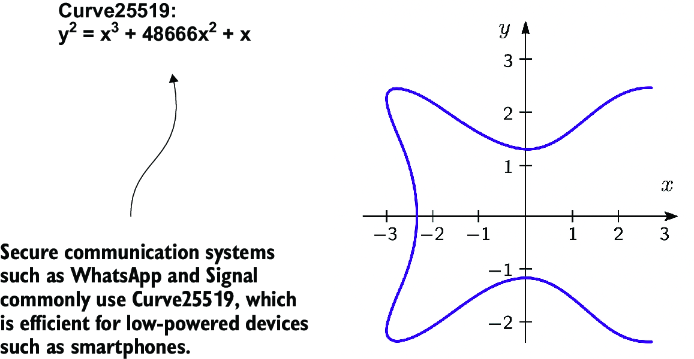
Visualizes Curve25519 and its role in efficient secure communication on low-powered devices. section 10.1.1



