The elliptic-curve discrete logarithm problem asks how many times a point was repeatedly added to reach a known final point. Moving forward is easy, but reversing the process is extremely difficult, making ECC a practical one-way trapdoor function. section 10.1.1 section 7.4
Its security role connects directly to practical cryptography:
- A fast algorithm for solving this problem would break ECC, just as fast integer factoring would break RSA. section 7.4
- ECDH uses elliptic curves to derive shared symmetric keys without sending the shared secret across an insecure network. section 7.5 section 10.1.1
- Approved curves such as Curve25519, P-256, and secp256k1 provide established choices; arbitrary curves may contain weaknesses. section 7.4 section 7.5
Figure 10.5 Color mixing as an analogy for key exchange in TLS. Alice and Bob each choose a private color, mix it with a public one, and exchange the results. Then they mix again locally to arrive at the same final color without revealing their secret. An outsider, even one who’s seeing the entire exchange, can’t reconstruct the final shared secret.
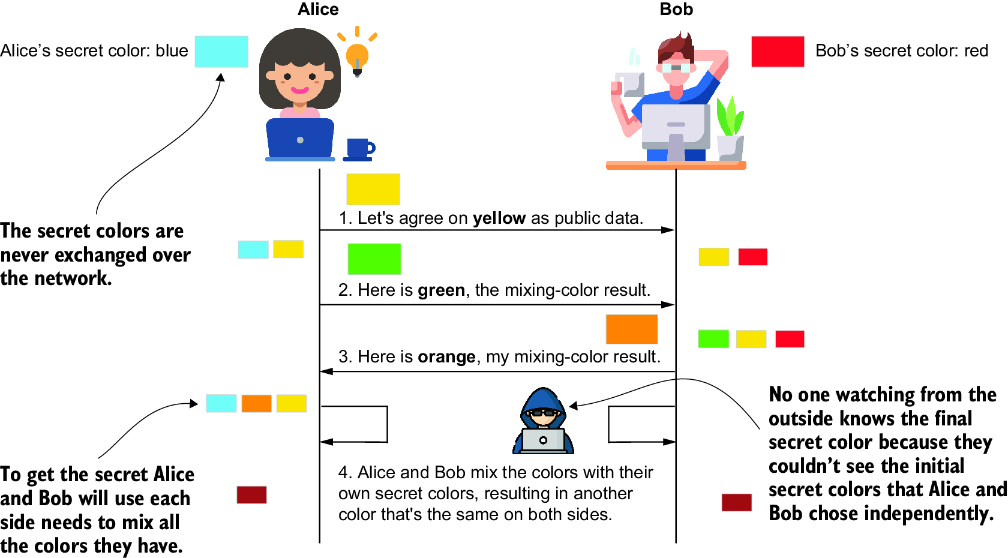
The color-mixing analogy shows how public results can be exchanged while private values remain secret and both sides independently derive the same shared secret. section 10.1.1


