Embedded real-time software controls dedicated devices while meeting timing constraints. It must be logically correct and temporally correct: producing the required result at its specified time. Embedded software is often called firmware. section 3.5
In robotics, the concept connects software behavior to physical hardware through:
- Low-level sensor data acquisition and actuator control running on dedicated devices. section 3.5
- Temporal determinism: computations must meet specified deadlines, rather than merely execute quickly. section 3.5
- Timing mechanisms such as worst-case execution-time analysis, preemptive scheduling, and interrupt-latency analysis. section 3.5
A braking controller
A car’s brake ECU must actuate the brakes within a guaranteed time after the pedal is pressed. Similarly, a robot controller may need to acquire sensor data and command an actuator predictably. section 3.5
Figure 3.13 A histogram of measured execution times under various system loads is used in worst-case execution time (WCET) analysis to find the longest execution duration and ensure hard real-time deadlines can be met.
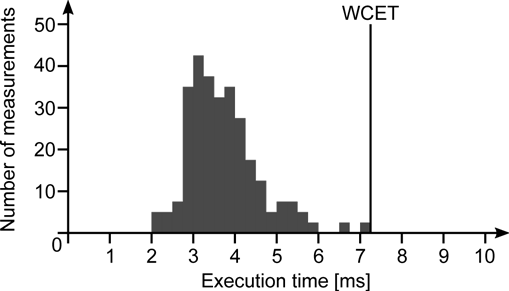
Use the execution-time histogram to inspect worst-case execution time and assess whether hard deadlines can be met. section 3.5
Figure 3.14 Preemptive scheduling ensures temporal correctness by allowing a higher-priority real-time task to pause and temporarily replace a running lower-priority task, ensuring both tasks meet their execution deadlines.
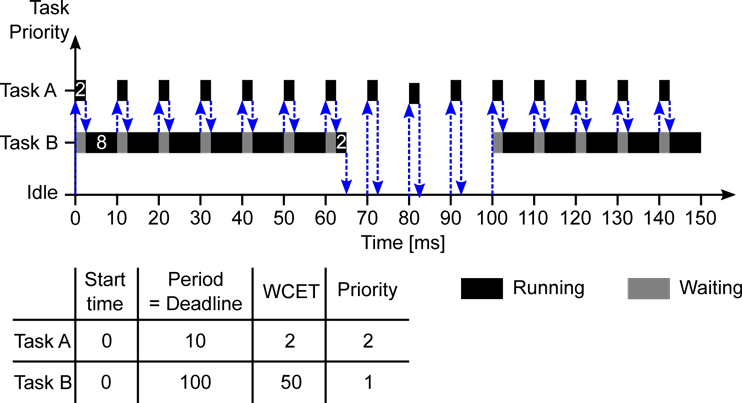
Use the scheduling diagram to see how a higher-priority task preempts a lower-priority task to preserve deadline compliance. section 3.5
