liveBook · Manning

Emission matrix

As explained in Machine Learning Algorithms in Depth

An emission matrix contains the probabilities of observed symbols conditional on each latent state in a hidden Markov model.

An emission matrix E assigns the probability of each observed symbol conditional on a latent state in a discrete hidden Markov model: Eₖₗ = p(xₜ = l | zₜ = k). section 7.1.2

Use the matrix to connect hidden states with observations:

  • Represent K latent states and d possible observed symbols with E stored as a K × d array. section 7.1.2
  • Keep each row as the observation distribution associated with one latent state. section 7.1.2
  • Combine E with the initial-state distribution and transition matrix when inferring latent states from emitted observations. section 7.1.2 section 7.8

Sleep–wake model

For a two-state sleep–wake HMM, E contains one observation-probability row for sleep and one for wake, with columns representing the discrete observed symbols. section 7.1.2

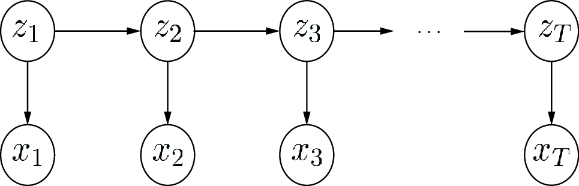
Figure 7.3 Hidden Markov model
figure

Inspect the HMM graphical model to see how the emission matrix connects latent states to observed data. section 7.1.2

How Machine Learning Algorithms in Depth covers it

How deep it goes
Defines conditional probabilities and a K × d implementation array, but does not detail how emission parameters are estimated.
Examples
Uses a two-state sleep–wake model and a discrete-symbol observation matrix.
What you can do after
Apply it via forward–backward inference to compute latent-state marginals from observed sequences.
How it connects
Connects latent states, observed data, transition matrices, forward algorithms, forward–backward inference, and EM algorithms.

Related concepts

This explainer was generated by Manning's knowledge graph from the text of Machine Learning Algorithms in Depth. The section links point to the parts of the book it draws on.