liveBook · Manning

Encoding interpolation

As explained in Learn Generative AI with PyTorch

A technique for varying latent representations smoothly to generate intermediate decoded outputs between examples.

Encoding interpolation varies latent representations between examples and decodes the intermediate representations into a smooth sequence of outputs. It turns a trained autoencoder or variational autoencoder into a tool for exploring gradual changes in generated images. section 7.0

A typical workflow is:

  • Encode example inputs into the model’s lower-dimensional latent space. section 7.0
  • Vary or interpolate between the encoded representations. section 7.0
  • Decode the intermediate representations to generate new outputs. section 7.0

Glasses transition

A trained variational autoencoder can generate a series of face images transitioning from glasses with dark frames to glasses with light frames. section 7.0

Figure 7.2 Generating a series of images that transition from glasses with dark frames to those with light frames
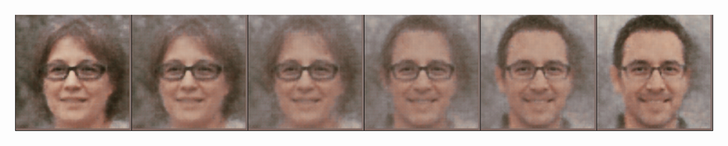
Browse the visual sequence showing a gradual change from dark-framed to light-framed glasses. section 7.0

How Learn Generative AI with PyTorch covers it

How deep it goes
Defines latent encoding and decoding, then demonstrates visual interpolation without detailing its mathematical procedure.
Examples
Uses generated face images transitioning from dark-framed glasses to light-framed glasses.
What it assumes
Assumes encoder, decoder, reconstruction, and latent-space concepts, while introducing their roles through autoencoders.
What you can do after
Apply it via a trained variational autoencoder to generate smooth visual transitions between examples.
How it connects
Connects autoencoders, variational autoencoders, latent space, encoding arithmetic, and image generation.

This explainer was generated by Manning's knowledge graph from the text of Learn Generative AI with PyTorch. The section links point to the parts of the book it draws on.