End-to-end testing checks whether an agent or multi-agent workflow completes a user task from initial request to final outcome. Unlike testing isolated components, it exposes failures at integration points: agents may miscommunicate, workflow state may be lost, or the system may fail to recover when an agent breaks. section 8.2 section 9.3.2
Exercise the complete workflow with cases that probe:
- Blended queries that require multiple capabilities and ambiguous requests that test routing. section 8.2
- Agent failures and state flow, to check resilience and whether information survives across components. section 8.2
- Regression cases that help maintain reliability as features change. section 8.2
For an e-commerce support agent, test a refund request from intent classification through the refund action to the final confirmation. A correct-looking answer is not enough to reveal every defect: inspect stages such as classification, parameter extraction, and action execution to locate hidden errors. section 9.3.2
Figure 9.6 The agent end-to-end testing and evaluation pipeline
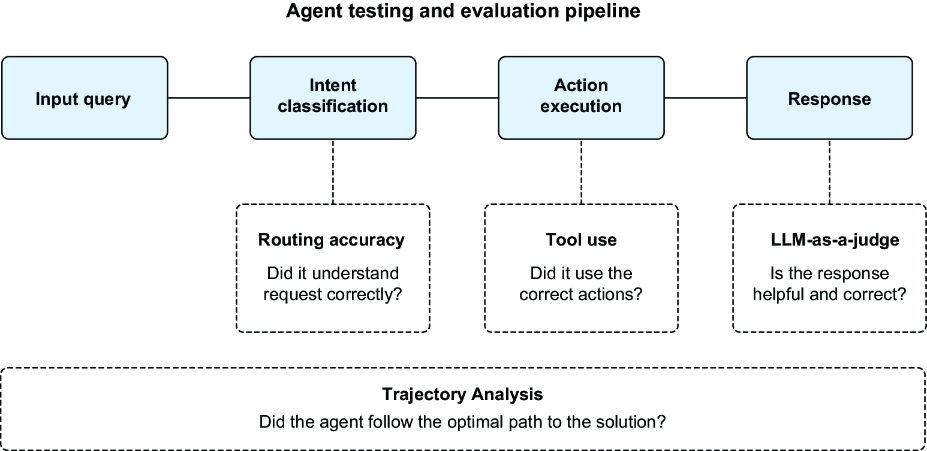
Use the pipeline diagram to orient a full-task evaluation before examining individual agent decisions. section 9.3.2











