liveBook · Manning

Endogenous variable

As explained in Causal Inference for Data Science

A variable within a causal model whose value is determined by relationships represented in the model and by associated exogenous variables.

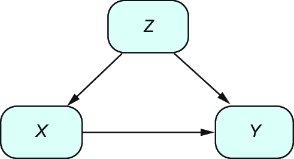
An endogenous variable is determined within a causal model by its represented relationships and by associated exogenous variables. In a graph with Z, X, and Y, each variable is endogenous: X depends on Z, while Y depends on X and Z. section 7.1.3

Unknown influences are grouped into exogenous variables such as UZ, UX, and UY. Functions describe how each variable depends on its parents and these unobserved factors, although the functions themselves are usually unknown. section 7.1.3 section 7.1.3

Figure 7.7 Typical three-node DAG with confounding. Z is a confounder for X and Y.
figure

Use the three-node causal graph to distinguish endogenous variables from the unobserved exogenous factors influencing them. section 7.1.3


How Causal Inference for Data Science covers it

How deep it goes
Defines endogenous variables through parents and structural functions, but stops short of specifying those functions exactly.
Examples
Uses a three-node graph with Z, X, and Y, plus unobserved factors UZ, UX, and UY.
What you can do after
Evaluate average treatment effects even when the exact causal functions governing endogenous variables remain unknown.
How it connects
Connects causal graphs, causal models, exogenous variables, parents, structural functions, and confounding.

Also explained in

Compare how 2 books explain endogenous variable →

Related concepts

This explainer was generated by Manning's knowledge graph from the text of Causal Inference for Data Science. The section links point to the parts of the book it draws on.